
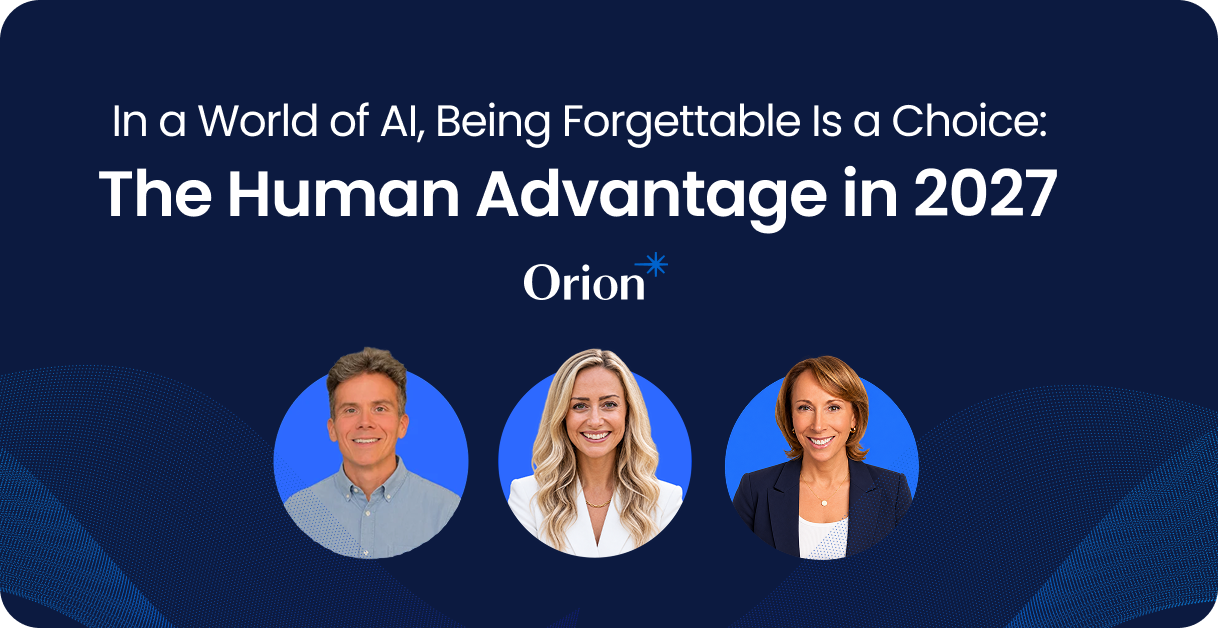
AI makes it easier than ever to create content and streamline your workflow. But when every advisor has access to the same tools, AI-generated content starts to look the same. By definition, it produces the average, and average doesn’t win clients. The real differentiator is content that builds trust, reflects your expertise, and shows clients what makes you you.
In this conversation, Orion’s Chief Behavioral Officer Dr. Daniel Crosby joins FMG’s CMO Susan Theder and Chief Evangelist Samantha Russell to talk about using AI for efficiency while keeping the human connection at the center. They cover why imperfection builds trust, how to respond when clients show up with AI-generated research, and how to write website copy that describes your clients’ real situations instead of generic labels, with live reviews of attendee websites.
Watch the replay for practical, behavioral science-backed ideas to help you build stronger client relationships, stand out in a crowded digital world, and turn visibility into growth as you plan for 2027.
Voici un résumé que vous pouvez consulter ou parcourir ci-dessous.
If, again, you’re not familiar with FMG, we are your partner for everything with adviser marketing. I’m not gonna spend too much time on this, but maybe tell us in the chat. Do you currently use FMG for any part of your business? We offer everything from websites to text messaging to outsource implementation, through our do it for me program, testimonials, which is huge right now.
So lots of different ways we can help you in your business. Oh, yes. And we love FMG. And we love you, Judy.
Thank you for the shout out.
So awesome. And Daniel, do you wanna give a quick plug for Orion?
Yeah. Of course. So Orion is is the most in one tech and TAM provider. We love our clients and I’m the Chief Behavioral Officer there. And so I do a lot with advisor education and helping our advisors be the best in the business at speaking to their clients and talking to their clients on days like this candidly, making sure that they’re listening and reassuring and coaching them up on days like today is why I exist.
I love it. Okay, So again, this is being recorded. We will share the slides and we will give you some good intel that you can use right after leaving here. So these are the main three things that we’re going to talk about today.
And again, we really want this to be a discussion and a follow-up. So less us just teaching you and more all of us talking. Because I think at the end of the day, there are so many people who, you know, now that AI is a thing, have positioned themselves as experts in this or that because of AI. But really, yes, a lot has changed.
But I think the more things change, the more certain things never change and are always more true than ever. And so we’re gonna talk a lot about that as well. So Daniel, did you wanna kick us off?
Yeah, I do wanna kick us off. So I just got off an interview with Michael Batnick. We were, of course, talking about AI. And one of the things that he was surprised about my kids are a little bit older than his kids. And I was telling him how viscerally my children hate AI art and AI marketing.
So we are at… So my kids are 17, 13, and 10. If we’re at the farmer’s market or somewhere like that, and they see what’s clearly an AI generated piece of artwork or a logo or something, uniformly, all three of them are like, Ugh, yuck, AI, hate it, AI, slop.
And so this, I mean, my question is for Susan and Samantha, what is underneath this and are you seeing this in our business?
I mean, I think one of the things that’s so interesting a year ago…
Maybe…
Well, actually, maybe, like, eight months ago, the first person came to me and said, look what Claude built me. Look at this website. And at a surface route level, it’s like, wow. You know?
This is cool. It built it so fast, all the stuff. But then I saw 20 more that looked exactly like it within, like, a month. And you start to dig in and you realize just because Claude can make a website or make a slide deck doesn’t mean it knows how to do it.
So I am public speaking every single week. The number one rule of public speaking is one idea per slide. Yet if I ask Claude to build me a slide deck, it has a thousand ideas per slide.
Right? I And And it’s, like, in in, like, four point font.
Yes. A 100%. And when you see people using it to do their, you know, social posts, like, completely, you can spot it from a mile away. When we were in Italy, some of, like, little trattorias, the mom and pop restaurants, were literally pushing people away because they would use AI to make an image of what was on the menu, and it looked so terrible. It didn’t look like this cozy, homey trattoria anymore. It looked like weird Rome… Roman eatery of the future.
I have to say, Daniel, I… I’m… I find that it might take… It takes longer. So with our do it for me program, we’re thinking about what content advisors should be talking to their clients about and trying to anticipate all the different things that are on their client’s mind. Like right now, should there be a timely email that they can send out to their clients about the market?
But this was all just content that we would write and strategize. And then AI can write it, but AI makes it awful. Not awful always, but there are just so many tell signs for that.
And now you have to make sure that it doesn’t sound like AI.
And sometimes AI can write well, but then you’re making sure that you’re taking out every actually and every em dash and every one of the three colon It’s phrases not and good.
Yeah.
But even if it’s good and it was handwritten, people are just cynical and like, that was probably AI. Like, it’s it’s a weird world right now especially as it relates to written words. I think the visuals are a real… Yeah, I am… I don’t… I’m not a fan of the avatars. I think the whole reason we’re doing this webinar is because we think your advantage is being human. And so leveraging AI for efficiencies is absolutely what you should do, and you should lean on the vendors that help you do that. But this is the time where your authentic self matters even more.
K. So I wanna I wanna pull on this string a little bit more because I think underpinning both the the Italian Trattoria and, you know, what we just talked about with Susan is that AI masks your uniqueness. Okay, let’s be real honest. There’s over 300,000 financial advisors in The US.
Most of them are really good. Most of them can do the blocking and tackling of the work quite well. And so the only thing you have going for you are the things that make you uniquely you like you are the best part of your business, your uniqueness. And when you’re a cafe that has the whatever, the croissant, the AI croissant, definitionally what AI does is average.
And I think, Susan talked about, yeah, some of the mistakes it makes and some of the things that it does, it’s always getting better. It certainly does those things. But I think even when it gets better, if you ask AI to draw you a picture of a croissant, it’s the average of 10,000 croissants. If you ask AI to give you opinion on the market, it’s the average of 10,000 opinions on the market.
That’s not what’s gonna put you ahead. That’s not your unique perspective. That’s not your authentic voice. And that’s all you have in a crowded market, I think.
So in some ways, I think it just leans into imperfection is your asset. We hear so many advisors, they’re afraid to do video because they want it to look perfectly produced. They don’t communicate as often to their clients because it’s a pain to write it. They want it to be perfect. And I think perfection might be the one way you actually look human. I mean, imperfection might be the one way you look human.
I thought what would be really interesting just talking about this kind of messaging is to think about…
For everybody out there listening, when you share anything that remotely tells your story, especially, like, social media is a good example. Because if you put it, you know, if it isn’t a client meeting, of course, it’s gonna be different. But some of you might do it on a blog, but if you’re on social media and you share anything remotely personal, those posts perform better than anything else. I’m sure everybody in the chat right now can think of a time they shared a picture or a story of their team or anything like that and how much better it performs.
And yet we we know this inherently, yet then when it comes time to write something, we just wanna give the four takeaways in our email rather than tie it back to something. Right? So I’m always thinking about what’s my…
If I’m an adviser, what’s my story with money? What’s my holdups? What’s a mistake that I had to learn the hard way? What’s a win a client had?
How can I lead with that personal story first and then share the takeaways?
Okay. I wanna share a little bit of psychological study here. I saw someone I’m getting brief glimpses of the chat. Someone was talking about how people are now making mistakes on purpose just to make it feel more human. It’s a funny place to be.
But there’s this famous psychological study on what’s called the pratfall effect, and it was done on politicians. So they had one politician get up and be flawless and robotic, perfect delivery. Second politician gets up, they’re a little bit bumbling, they’re not super sharp, the delivery’s bad. And then they had a third politician get up and the politician trips a little bit on the way up to the stage, spills a little coffee on the shirt, makes a joke about it, and then delivers, you know, delivers a speech that’s, like, 85% good.
Right? You know, 85, like, competent, but not perfect. That was the one that voters overwhelmingly liked. We don’t like, you know, we don’t like bumbling idiots, but we’re skeptical of sterility.
Right? We’re skeptical of perfection too. And there’s something really laudable and something really lovely in being human and being flawed and showing that to our clients.
By the way, if you have kids and you do a prat fall, they will laugh every single… Like, if I want… If the the energy in my house is bad and I wanna change it, if I just pretend to fall down, my children will all just stop whatever they’re doing and start laughing. It is hilarious. I love that. But to your point, you know, I say this about testimonials all the time. We’re really trying to explain the role of social proof in marketing.
So many people are scared of getting one bad review that they don’t wanna ask anyone for a review. But psychologically, if you look up anything, whether it’s a pair of jeans, a hotel, a plumber, a financial adviser, and they have 500 reviews that are five stars and not one person says one negative thing, you think it’s fake. It… It’s too perfect. It doesn’t seem real. And so actually getting one bad review in some ways is the exception that proves the rule.
Yes. Totally. And that is so true. I I mean, all of us look at reviews before we buy most things, whether it’s travel or Amazon or whatever. And yet the number one reason that we hear from advisors that they are not using testimonials is that fear. And Daniel, I’m sure there’s something related to fear of feedback. Loss aversion is way stronger than the attraction to the upside.
That’s right. They call it the ostrich effect. I just plug my ears and forget about it. But, you know, one of the things that I’m thinking about as you say this is we have good research on why people fail to seek financial advice. And the number one reason people fail to seek financial advice is fear of judgment.
I think want yes, I see advisor from the advisor, they’re fearful.
They’re fearful that the advisor will be so buttoned up so perfect have their life together.
They’re going to come into the advisor’s office, lay their financial life bare, and then effectively the financial advisor will laugh at them, right? And I think one of the things that we can do is if we’re we need authenticity from our clients, right? One of the things about financial advisors, they have to have hard conversations about an emotionally laden topic. We need to model that for them, right?
We need to model our own imperfections, our own failings, our own mistakes to be candid about those. That’s not going to turn people off. It’s going to make them more drawn to us and feel more comfortable with us. So just one more reason to do Sam’s thing and trip down the stairs for your kids.
Daniel, I have an interesting…
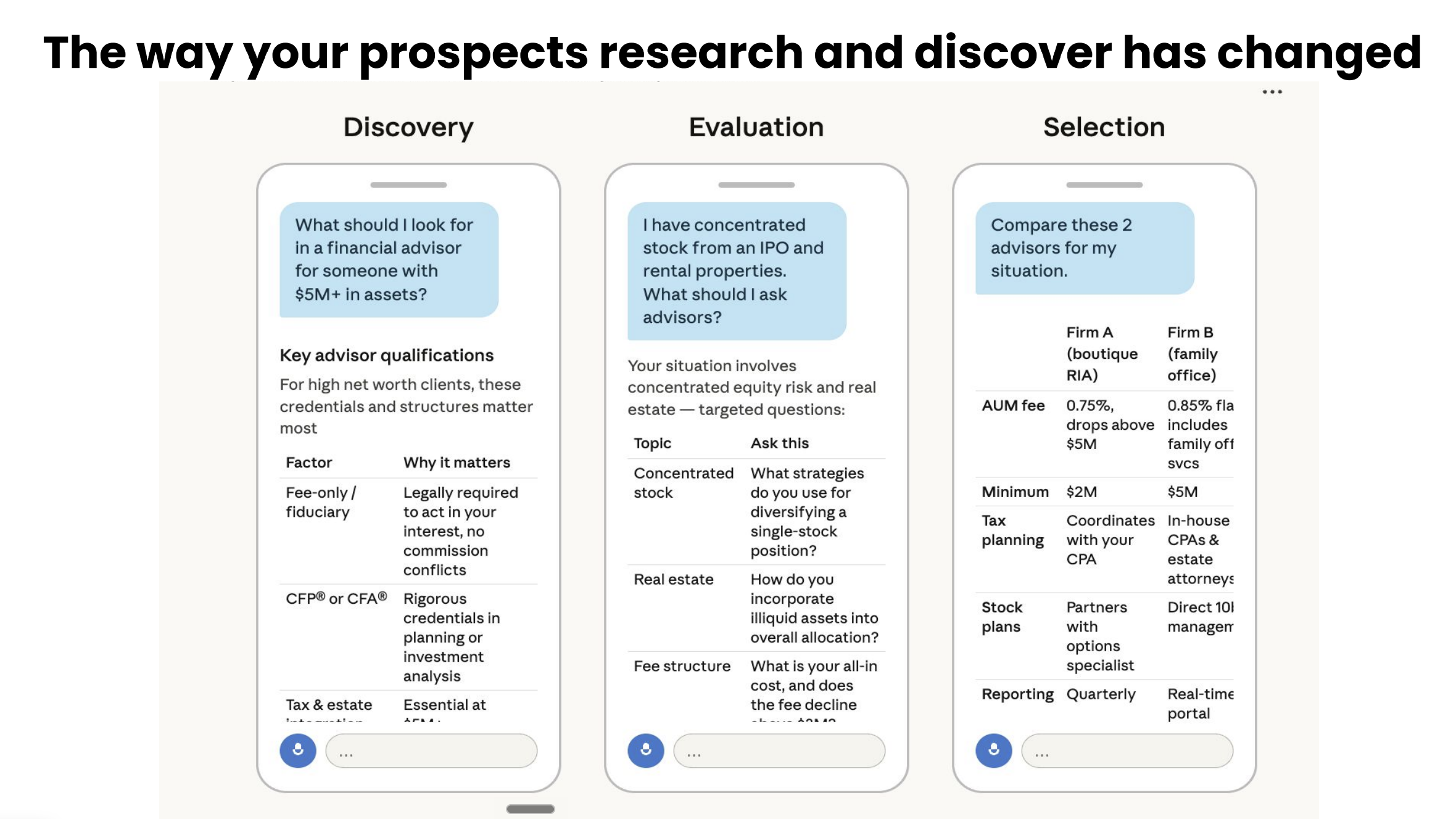
It’s not quite devil’s advocate, but I think as we get into practical advice for our audience, I’ve written a couple of bylines, and I think more and more, and I’d love to see in the chat, clients or prospects are coming to the advisor way more advised or briefed or having done research on one of the LLMs before they have that meeting, whether it’s in person or in Zoom, they’ve asked a bunch of questions. I think they showed that the top searches in chat are all financial. So more often, and it likely will just continue, advisors are going to be meeting with clients or prospects that are actually potentially challenging them or coming in with this 20 page document that they have to really find fault in.
And they’re, you know, so instead of showing their humility and and doing, you know, where they have insecurity.
That’s more for the people who already have an adviser though than like the prospect. Maybe.
I mean, I I I think…
Let’s see from Tell us an audience.
Are you having clients bringing in these AI pronouns or saying, oh, I asked Claude this, or is it more, you know, prospects?
Because I would picture it being I mean, I will say I have a financial adviser, and I absolutely kind of was testing.
I actually signed up for Range, which is AI wealth management tool, just to see if it would be different. And just to kind of pressure check what I’m getting from my advisor. And I mean, I’m in the business and all that, but think the trend, I think we have to assume that more and more the people that advisors are meeting with, if they have a question, they’ve probably typed it into chat before they get there.
Okay, I almost did a spit take with my fresco there because someone typed yeah, but I’m not reading that. Cracked Okay.
Me So, Susan, you can’t bring stuff like this up in front of a psychologist and not get put on the couch. Here’s here’s here’s what we’re going to do.
What was the underlying motivation? When you when you when you got the second opinion for your financial adviser, did you give that to him or her?
Actually, I’m gonna blame it on my husband. It’s more him. But… So let’s say we’re having a meeting with our financial adviser. Beforehand, he does all this work in, you know, Claude or whatever, and he has an agenda, and he’s got, you know, our questions that we were gonna ask about this tax situation, this rental property, like all the financial planning stuff. Nothing about investments, all planning oriented things and tax optimization and estate related topics. And so he wants to be educated so that when we get advice, he has an opinion or something to look for. And so he’ll bring that document, he sends it to them in advance.
And I apologize because I’m like, I’m so sorry, sending you that 13 page document. And then we go through it. And in every case, the advisor has been able to both say, That’s great feedback. That’s a good point. But also say, Well, remember, you also have this and that happening. Therefore, this is a good answer for somebody isn’t in your exact situation, but in your situation, that doesn’t make sense.
It’s the average answer, not personally.
Yeah. Yeah.
Yeah. It’s the average answer. Because, yeah, my assumption is, again, this is the shrink in me. I’m looking for the subtext, right? Like, what is the what’s the question beneath the question? So if I’m a prospect and I’m bringing this in, like, what’s the question? What’s the real question?
I think it’s it’s it’s like pressure testing whether they try. I mean, would say my husband is I really trust her answers? Does she know as much as Claude?
Yeah. Yeah. I think it, I think in your case, it probably is trust and I think sometimes maybe it’s a fear of judgment or like a focus on the wrong things. You know, I’ve talked to certain relatives in my family and it’s like all about performance since you have to do some education around that. But for the advisors, I, you know, I won’t rehash the whole story. We told it in our last conversation, but I talked about buying a new car and bringing in, you know, some comps to the car dealership and the guy got really frustrated with me and I ended up buying a car from a different place.
And I think there’s, I think we sense that lack of trust or we sense that pushback. And I think we want to look for the question beneath the question and make sure we’re addressing the right thing because I don’t know that it’s always what’s on the paper.
So what should an adviser do if a prospect and or client sends in advance and and comes to the meeting with, you know, a five page document that is a printout from Claude?
Yeah. So two two things.
First thing fire the client.
That’s what Jeff Well, I think you’re gonna get lots of the kindly fire the client, man.
Jeff Jeff’s the one that said, yeah, I’m not reading all that. Jeff’s a legend. I gotta I gotta hang out with Jeff. So I think I think the first thing you need to do is be nondefensive.
I think that’s the I agree.
I think that’s 90% of the battle because I think most people are gonna get that print out. They’re going to feel defensive about it. They’re going to be edgy and And on their then like, let’s say lack of trust is the defining consideration here. Well, what do you do when that advisor starts acting cagey?
Like, well, that’s now the trust is further eroded. So I think the first thing and most important thing you need to do is not get defensive about it. And then the second thing is kind of what I talked about before, Try to speak to the underlying concern, right? Like, what is the underlying concern here?
Like, yeah, it’s it seemed like it’s and giving voice to that. Say, hey, you know, miss Mr. Theater, it seems to me like, you know, we’ve been working together for a while and, you know, it seems like things have been going well. But here I got this 13 page printout and well, you know, like, what are what are we doing here?
Like, is this a lack of trust? Do you want to make sure are there things we haven’t discussed? Would try and be non defensive and then try and get to the heart of the matter because I feel like you risk answering a question that’s not being asked.
I love that. I think that’s so true. I I do think…
And I think it’s gonna happen more and more to advisors unless they’re ignoring it and firing the client. And I think to that point about fear of being judged, I think reacting negatively makes that person feel even worse. But if you say, look, this is great. You’ve looked up all this stuff. I’m not sure exactly the language, but complimenting them for doing some research and loving the interest in it and saying, let’s go through this together.
And then as you do that, you probably will find opportunities where you can be like, that’s a great point, except for in your situation, it doesn’t work. Suddenly you’ve just taken that opportunity to gain tons of trust. Like you actually can show your value proposition live as you point out flaws in what probably is an answer for the average.
Well, yeah. And I’m I’m reading some of the comments here. You know, one one person said, encourage my clients to use Claude, and then I was getting a fragment of another one. I think that’s a really evolved way to talk about it because you say, hey, look, it’s important to me that we’re on this journey together, and I appreciate you. Like, you know, I appreciate you digging in and being an active participant in your own wealth creation.
Exactly.
Now let’s talk about the ways that Claude tends to give average answers that are good for people in general, but maybe not your family in specific. Let’s see where it fits. Let’s see where it doesn’t. And like you said, show that non defensiveness, encourage them, but also also show your demonstrate that value.
I thought it would be interesting to look at a couple marketing examples that Yes. Okay. Some of this human side of things. And I’m gonna invite everybody in the chat whether you have a website you’d like to take…
Have us take a look at. Maybe we can help you come up with ideas of how to better humanize it, tell more of your story, or you had a social post maybe that you want us to look at. If you wanna be the guinea pig and have us pull yours up, you can drop the link into the chat. But let me show you one.
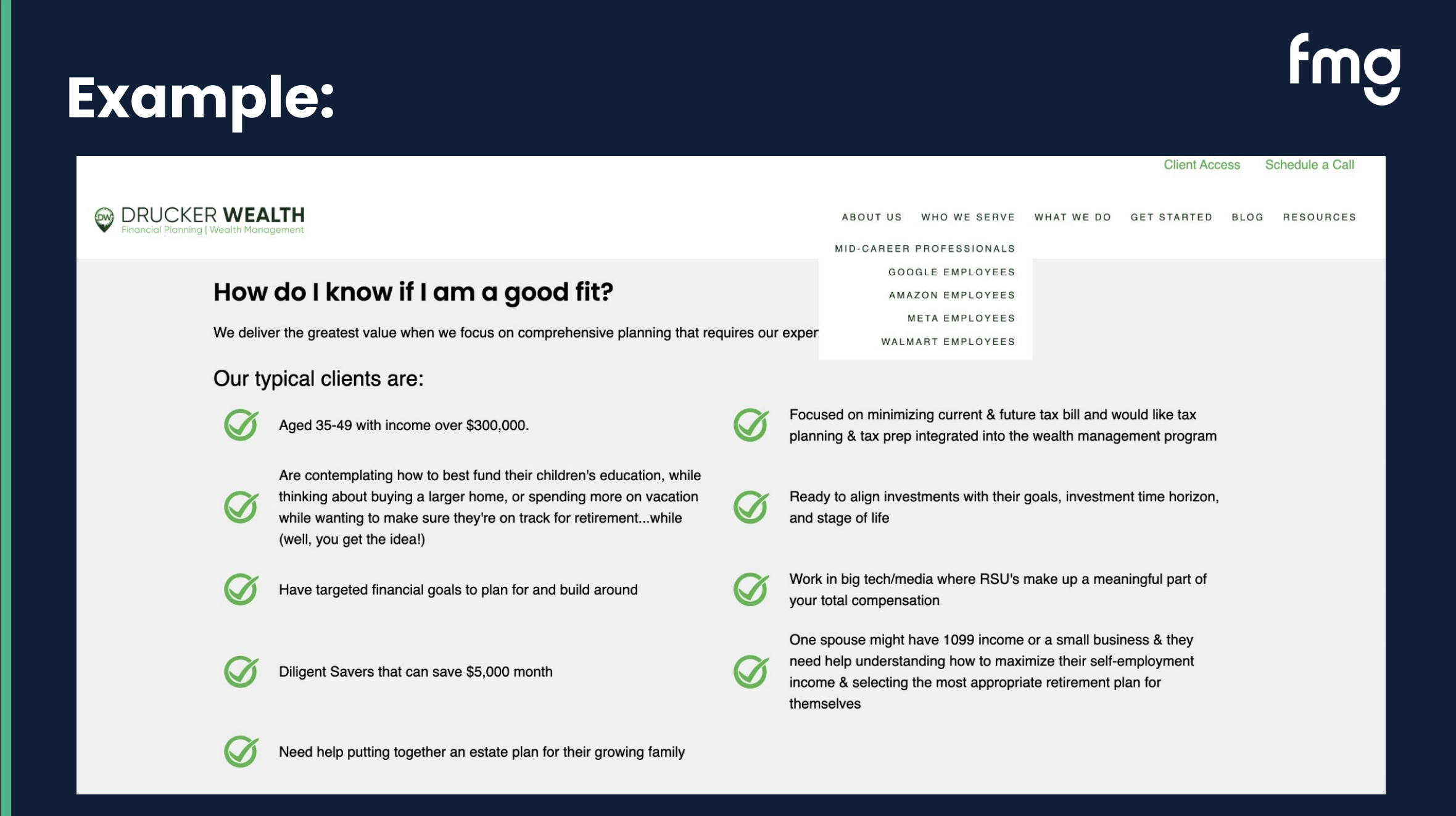
You were talking, Daniel, about people being sometimes nervous or not knowing, you know, is this adviser gonna judge me? Right? I love this as a version. Has anybody done something like this before?
Whether you call it success stories, case studies, where you talk about a version of a kind of client you help. This can be anonymous. This can be an…
What’s that called? Algorithm? Algorithm? No. Where you take a bunch of versions of something and make, like, a story out of it.
Amalgamation.
Very good. Amalgamation.
I can’t say the word, but I get points for knowing what it means.
No.
So This is so great.
We’ve… I’ve never seen this example. I love this.
So it’s like, you know, here’s who the clients are, how old they are, and then what’s the situation? And it talks about what they don’t know, maybe mistakes they’ve made, and then what the firm’s approach was and what the results are. So somebody visiting your website can really picture themselves in this same scenario. Right? And they have lots of different versions.
As can the answer engines.
Yes. And this is a really, really AI. The LLMs love this a 100%. But if…
Does anybody else have anything like this or something they’ve done? This really, really helps. Right? The robots find you and match you with the right people, the LLMs.
But then the humans, when they land there, they’re gonna see what they can envision. What would it actually be like to come to this advisor with these problems, desiring these outcomes, and what it would look like to get there.
Okay, Sam, let me, can I kind of run with this for a second? Humans think in stories. This is so powerful because humans think in stories. Our brain accounts for two to 3% of our body weight.
It accounts for 20 to 25% of our caloric expenditure in any given day. We are always looking for a way to just say what has worked for other people and can I just do that? Because it allows us to kind of put our brain in cruise control.
Nine out of ten dentists choose Crest. Awesome.
Like like one, you know And social proof in case client Yeah.
Correct. One less thing to think about. Right? So, yeah, create these archetypes, these amalgams, right? These amalgamations of just the different sort of ideal clients and let them see themselves there. When we bought our last house, the thing our realtor said, it was brilliant.
You know, this was 15 ago, so I was quite a bit younger, but she said, look, if you’re a parent, a well educated parent who cares about the best educational outcomes for your children, this is the neighborhood to live in, right? She put me in a box that I really wanted to be in. I saw myself there and I made a decision. This is a great, great example.
That is great. I’m gonna show you one other thing. I just actually posted this the other day, but I think hopefully this will be helpful.
These are the kinds of questions that people can envision themselves in, right? Should I still contribute to a college fund for my kid? Will a four year university degree even matter in ten to fifteen years? Is there a better investment vehicle that’s less restrictive if it winds up not being as important?
If I wanna own a property abroad, how will that impact my taxes? So instead of saying, we help you plan for college, you want to talk about the exact question that the person is having that’s leading them to need that plan for college. And you can often use that in, again, storytelling. We had a client come to us.
They were worried about investing all this money right now in a college fund with AI. Is it gonna change education in the future? We helped them come up with a plan that and then talk about what it is so that they walked away feeling confident. There’s an adviser I love on LinkedIn, and she, every week, recaps basically the questions clients came to her with and what…
How they work through them and what the outcome was. That is such a great way to, again, humanize this whole thing. Because to your point, Daniel, I think at the end of the day, someone bringing that AI printout, they want to make sure, are you catching these things? Do you know about this investment vehicle?
Are you paying attention to these headlines?
And so when you just rephrase it in their language, they think immediately, okay. Yes. You get it.
Yeah.
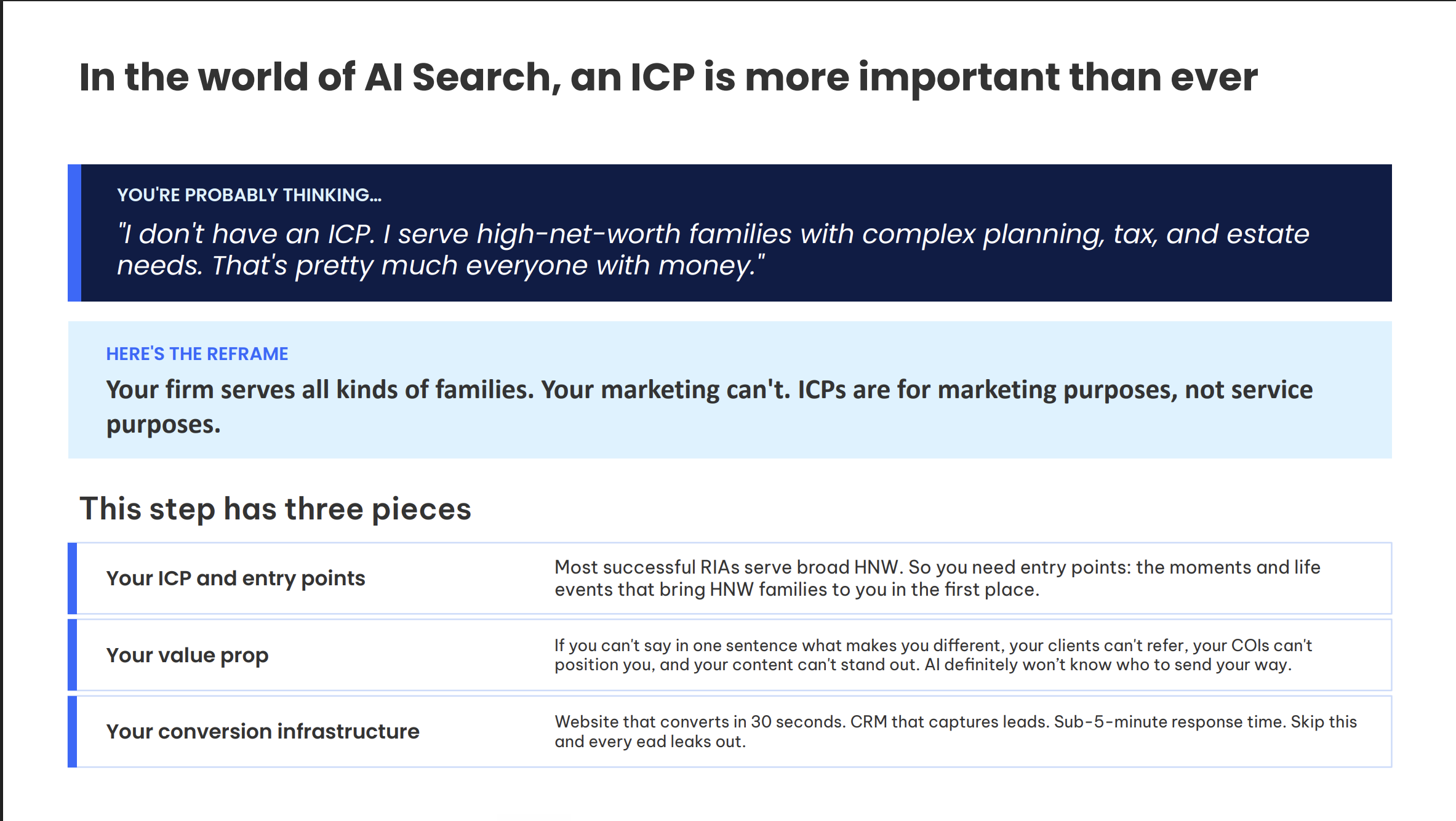
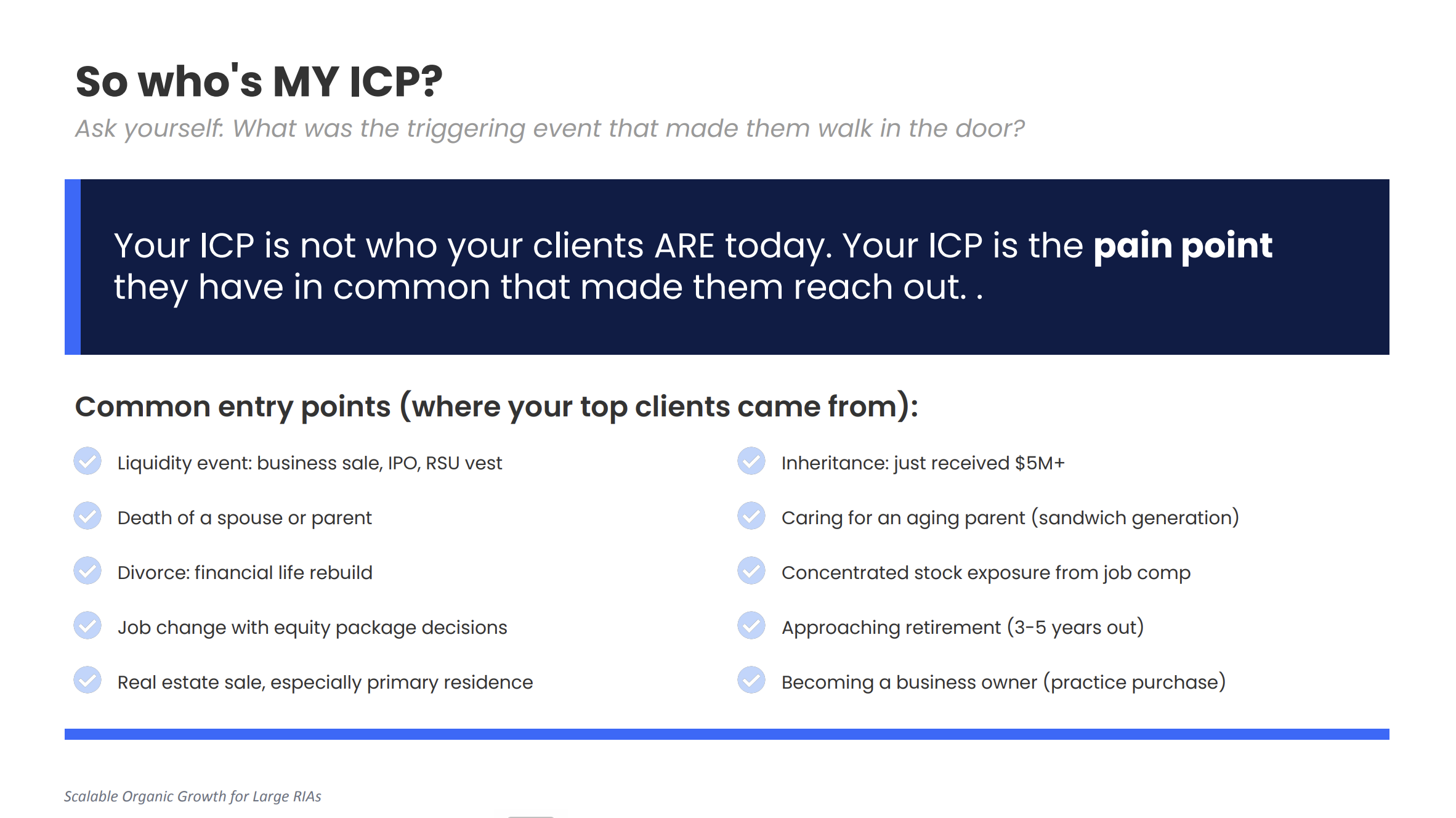
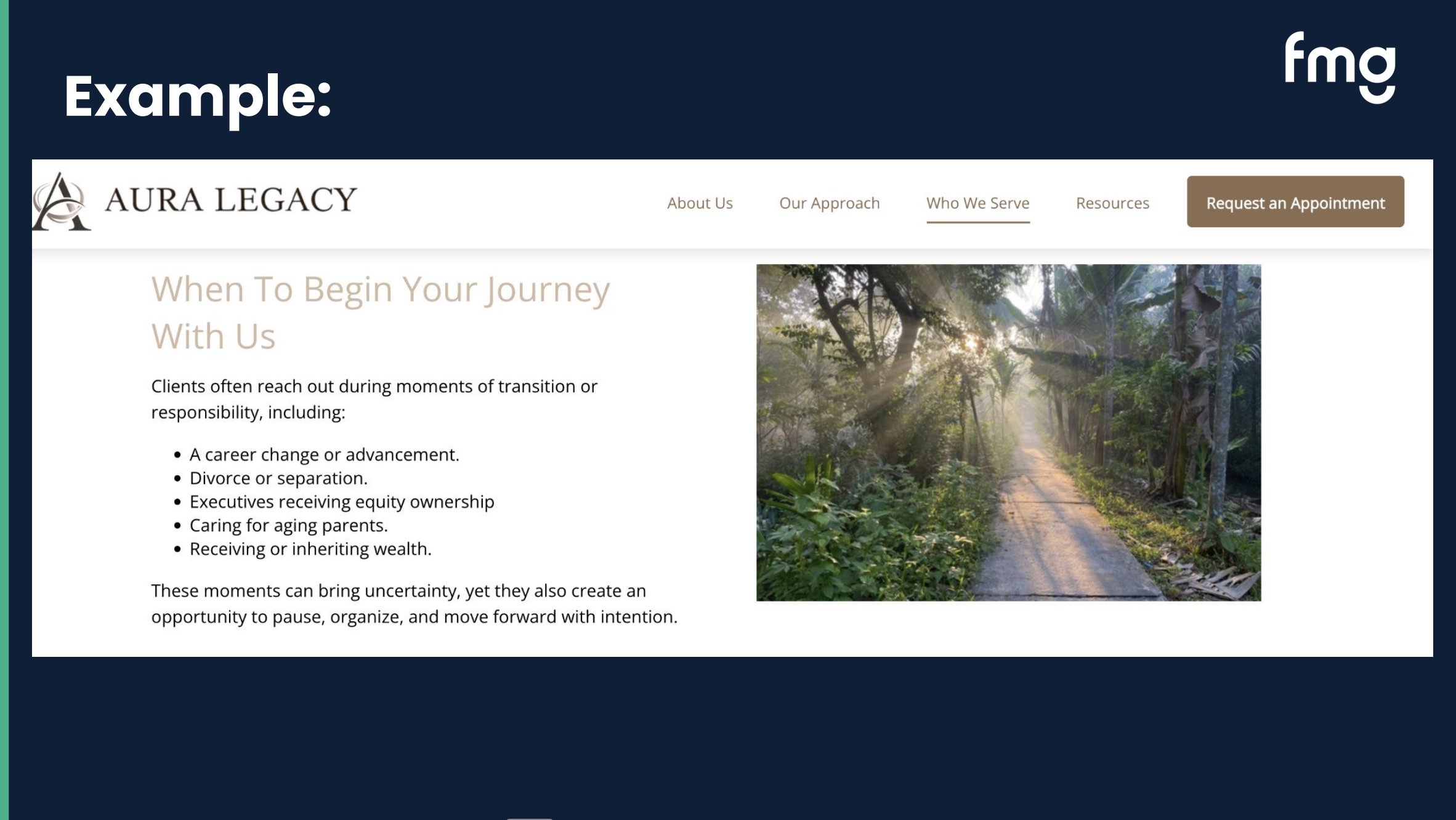
So true. And, actually, like, we think about your ideal client profile. I think everybody has in their website, they’ve got the who we serve and their services section. And what we’re seeing is that you should be describing the situation, not the label.
So you might say college planning, like that last website you show. I think they actually even said situations. What do they call it? But I think it was situations.
Describing the situation and then what you did, we will…
The situation might be a business executive with a liquidity event in their future and describing that situation and the anxiety or fears that they may have or questions they may have and then what you’ll do. We’ll meet with you and talk about whether you can leverage this, that, or the other thing or open a DAF to mitigate taxes. That kind of language speaks to people and better describes things than just that label.
Yes, 100%. Okay. So we had a couple people put in the chat their website. So let’s… Thank you for being brave. Let’s look at a couple. Here is Kitty put this one in, Anastasia and Associates.
So again, when we look at a homepage, what I’m always looking for is can I tell just by looking at your homepage who you are, what you do, and who you serve?
So, yes, we know who you are, what you do. You do have it in your title, wealth management, but I think this type of language is truly too broad. It’s it’s too generic. I hate to use that word, but you wanna get way more specific about who you specifically are working with. So you have here some of those things, which is great, but I would update that hero copy at the top of the page to get even more specific. Susan, Daniel, what are you guys seeing?
Same thing. I mean, so business owners seeking a long term strategy, not quick advice. I think, you know, business owners who are contemplating succession or future liquidity events and wanting to manage both estate succession and tax optimization. I mean, just spelling it out a bit more, that’s too long. But again, I think, Daniel, it’s really about saying it in a story mode so that it resonates more with the people that are reading it.
I agree. So I have a question for our two experts, Susan and Sam here.
When she’s talking here about we focus on working with high income professionals, high net worth individuals, I know that a lot of times people who are objectively wealthy don’t see themselves as such.
Do you think people, you know, someone who makes $500,000 a year and who is objectively a high income professional, I know a lot of times they see themselves as still middle class. Do you think people recognize themselves in this copy?
Not always. I think it’s more about defining where their brain is at, what questions. And that’s why I love when people will say, do you have questions like… And then they’ll list out the types of questions that people have instead of bucketing them into some sort of demographic. I think focusing… I… Maybe I have another example here.
Like, for business that I just typed it in. Before or after liquidity event, the sale of business, a partner buyout, or succession. And I think the wealth question goes either way on whether people see themselves.
I don’t have a strong conviction. Don’t think that wealth is a word that you should stay away from, but I agree that many think they are not as wealthy as high net worth. I almost feel is less resonant than saying, affluent.
Affluent. Feel like a lot of people maybe… Yeah. Affluent.
But those are labels, these aren’t stories. Yes. So I think to your point, the label doesn’t mean anything. It’s describing my situation that means something.
Yeah. It seems more like an industry term than it does a term people would use about themselves.
Exactly.
Me look at another example.
Qantas Wealth Management, Integrated Wealth and Tax Planning in Northern Virginia.
I like here where they’re focusing on the outcome slash benefits. You know, you’re gonna synchronize your portfolio, taxes, and estate plan.
That’s… You know, you can maybe even get more specific, but focusing on outcomes is good.
They’ve got different pieces of the puzzle kinda coming together. What are your thoughts on this one, Daniel?
Oh, I’m going to leave it to the experts here. I’m not I’m no I am no website expert. I will take the take the fifth on this one.
Well, go back up because I love I love that they’ve got the geography. So, integrated wealth and tax planning in North Virginia, Northern Virginia, that speaks to people just even just by stating the location and integrated is a bit of a buzzword but people…
Like I just described the situation that I was talking about to our adviser. It wasn’t about investments. It was about it was about estate and tax. And I think those things describing those situations in a story format and showing that you bring that together, that is, I think, what people are looking for.
Somebody that sees the full picture and fixes that pain point where most individuals feel like, I have three different people. I talked to a CPA and a state attorney and I’m worried that it’s not optimized. I think most people worry about that. And this visual, did your eye go to the puzzle first or the text?
Mine went to the text. How about yours?
Mine went to the puzzle. What we find is that most people, I’d love to know in the chat, what did you all see first? Was it the puzzle or the text? Because people typically will look at a visual first before they will read the text.
They were getting mostly puzzles. And that puzzle really says so much without you having to say so much. So when you can really incorporate a really powerful visual, you can get your message across so much faster. So that is a really great way to do it.
Someone said the puzzle pieces aren’t readable.
I would say maybe… I bet all of us that said text are older and, like, it looks too small for me too.
Puzzled with puzzling, so the text.
Puzzled with puzzling.
One thing I also will mention is certain things that you wanna do for the human and then other…
And in your marketing and then other things you do wanna do now in this LLM AI search world to help the LLM send people to you. So one thing is if you do have any awards like this, you want to list them 100% at the firm level and then buy individual advisers. You’ll have a much better chance of the LLMs finding you because they’re often looking for that. But this is an image.
You want it to be readable by these crawlers. So you can’t just put the logo. You need to list it out in a way that it can be scanned. So whether that’s the alt text on the back of the image or just actually listing it out.
Just a couple of those to mention.
Okay. Can we go to the about us page? Okay. Again, I know just enough about websites to be dangerous, but I know that that’s the most trafficked or one of the most trafficked.
Yeah. It goes home page, then about, or team page.
Yeah. So when we’re talking about being human in the age of AI and standing out in the age of AI, what are some FMG best practices on the about us or the team page?
Love that question. So number one, let’s just click on one of these adviser bios. So you click on there.
I really push people to write their bios in first person, not third, and to make it, again, that human story. If you were sitting across the table from me, what would I say? Sometimes that can be difficult to write it in first person. If you can make it almost like a magazine is interviewing you. I know Susan, actually your advisor does this. There’s another advisor that we work with that does this where it’s like, what made you get into this business? Or what types of clients do you work with?
But also, yeah, that. It’s, like, this is a resume. The about us, I think advisors tend to think that it’s the credentials that matter the most and credentials are important. But the reason people choose you is because of trusting you and who are.
So writing your resume is sort of a…
I think it’s an obituary.
It sounds like Yeah.
But what people want you to do is describe who you serve, potentially why, and what you do for them. And that is a story format versus just… I mean, the Forbes, but all this… All that social proof, that’s all great. But the third person resume is… That could be the bullets at the bottom.
Yeah. What what about putting video? I find myself wanting to get Rick’s vibe here.
Like, is is video I think so, Sam.
Right?
Authentic video. Intro video, like, that says, you know, something about you. I’ve also seen advisers. I was trying to actually find on my phone an example, but I couldn’t find it, where they actually have their, like, personal photos of their family or them traveling Yes.
About them. And then we’ve had people that do really funny things where it’s like a bar graph of how good they are at different things. Like, financial plans, a 100%. Building tree houses with my kids, 90%.
Playing the harmonica, 10%. Right? And just sort of, like, anything to tell a story and be more interesting. Human.
I mean, I think this all fits into the the world as the as the world becomes more AI focused, AI forward, all the ways that you can lean into the human part are going to be your differentiator. So website is a great place to show more of the personality and the human, and that is why people choose you. It’s that they connect with you. They trust you. They believe you’re gonna care about them and their family.
And then for the AI for the AEO optimization, yes, you still wanna list all your credentials, all your awards anytime you’ve been mentioned in the press. But put that after the story and the connection because the AI bots are gonna read that and leave. It doesn’t matter. The human, we wanna put that up at the top for them.
Talk about videos. We gotta… What do you think about AI video? And then somebody asked, can AEO or can the LLMs read the video?
So two things. I’ll answer the second question first. You always wanna make sure that you put the gist of what is in the video as either the transcript underneath it or the text summarizing. So if it’s a welcome video, you would just put basically what you said. If it’s a long video where you were on podcast, so you’ve embedded the YouTube, you wanna put the transcript below it. And that will allow the LLM to get all those keywords, all that context very quickly.
So the the subtitles don’t do it. You’ve gotta add the transcript.
Exactly. What do you think Daniel about AI avatar videos? Do they help trust? Do they help people trust you?
So I have played around with these quite a bit. I can’t look, I can’t get them to feel authentic, you know, because I do a lot of writing. I’ve I’ve played around with the idea. You can kind of train it. You can feed it, you know, your real videos that I’ve done and then say, okay. Read this long script.
I can’t get it to look non uncanny valley currently, frankly.
And I I mean, I wish I could… Like, I really wish I could. I gave it a real effort and then ended up just having to pay a bunch of money to get, you know, to work with some professional videographers to do something that’s a little bit more authentic because it just felt uncanny.
I think it’ll get to a place where it Yeah, I do.
I do think it’ll I do think it’ll get to a place. It’s already honestly very impressive, but it’s just strange enough currently that I just don’t think it’s there yet.
Even on Instagram, there’s whole Instagram influencers that are fake people that, like, you know, all these videos, and I think it’s easier to fake people out when they’ve never… There’s not a real human. Like, to make a fake one, you can make it much more realistic than when you’re trying to make a AI version of a real human as it stands in 2026.
You know what? It’s probably the same thing that’s happening. It’s probably analogous to content. You know, right now, everybody’s skeptical.
Was that AI written? Was that…
You know, and looking for cues? I just…
You know, I went to I went to Paris last weekend, and so people thought, you know, they’re like, oh my gosh, the riots and everything. So we, as a joke, took a picture of ourselves and just put some protesters in the back, and I sent it to some friends. They’re like, oh my god. And then I’m like, no.
That’s AI. And I don’t know. Have you guys watched the show Capture? Has anybody in the chat watched the show Capture?
So it is about how governments or even, you know, people of ill repute can use video hacking and avatars and, you know, fake video to influence all sorts of things, create fake evidence, whatever it might be. It’s a really, really great show. But I bet in… We’re probably on the cusp of everybody critiquing video to say, is that fake? Is it not? And just being skeptical.
It’s an interesting world. I mean, like you said, it would be great. Like, Sam does tons of videos. It’d be awesome if she could just voice text into her phone and say, make that my real video, and maybe it’ll get there.
I don’t know. I’m sure eventually. Okay. Let’s keep going with a little bit of time left. Let’s do one more website that was submitted, and then we’ll move on to some other other ideas. What’s this one?
Oh, that one said it didn’t support a secure sale connection.
MCF advisors. Can you guys see this one? Is my screen shared? Yes. Your wealth, your taxes, your estate plan, one team, one place. I like that.
An independent adviser firm with advisers, CPAs, and estate planners in one team. You know what I love about this? Whoever submitted this, they’ve got their offices.
They’re talking about one team, one place. They’re using the words a client would use. Client would go and ask ChatGPT, I just want one team to help me manage my taxes, my estate plan, my money.
I laugh at how many people still have holistic financial planning. No one is asking an AI bot, help me find a holistic financial planner. So using your your customer, your prospect’s actual real language… And now that everybody has AI notetakers, you have a treasure trove of their real language and the questions they ask. Use it. Use it.
This is great too. What brings you to m And t they can…
You can kinda look through about…
And I like all of the you language. Yes. For business and personal finances, managing your wealth and your taxes. You know?
And this one, I might even change this to be like a problem, like…
Or what you want the outcome to be rather than a statement to be you want to manage your wealth, your taxes, your estate plan in one place. Danielle, I’m sure with all the research you’ve done, do you find that people respond? Because there’s different schools of thought, more to marketing copy that’s focused on the outcome that someone is going to get or the idea that first establish here’s the problem and then deliver what the outcome is?
So there’s there’s two things that I really like on here. One is the psychological term for it is salience. Right? We want to be able to visualize, we want to be able to put ourselves in the cockpit of the situation, right? And so that’s all the you language there, it’s highly salient. And if you scroll down just a touch, yep, there you go. When did your advisor, your CPA, and your estate planner last sit at the same table?
What I remember I just said, I’m like, I feel like that’s something I would really love.
Yeah, so they’re like almost prompting a negative, right, they’re like, hey, it’s been a minute or, like, yeah, that’s not happening. And we know because of loss aversion that, like, people are more motivated by, you know, not missing out than they are even gaining something. So this is highly salient and it uses real behavioral prompts. This is super effective. And then, like, I’ve seen a lot of comments and I agree that the text is just pleasing, like the font is pleasing, the color contrast is easy to read.
Yeah. This is an exceptional… I mean, that section right there literally just described, oh my gosh. Then they have these FAQs.
Worth asking. I… Should… We we need to, like…
And I… What I like about this is worth asking anywhere. It’s kind of like, even if you don’t work with us, you should be asking these questions, which is just another way to build trust.
Yep.
So Yeah. And giving things freely, we always say that is one of the best marketing strategies is just to give information freely that people value.
Yeah. This is another page. So they’ve got the different individuals and families, business owners, corporate plan. Notice though that…
Remember I made a joke about, you know, so many people will just say, we work with businesses, families and individuals. But you don’t feel that way when you come to this site, you’re just, oh, they work with everybody. I always…
One thing that…
This really helps people get it. I know you both are married, but when you were dating, did you wanna date someone who would literally go on a date with anyone? Because I only wanted to do that. Right?
Like No.
You wanna be with someone who’s picky that they they will be with… And that same thing is in this profession. You don’t wanna work with an adviser who literally will work with anyone off the street. You wanna work with somebody who works with people like you that gets it. And so even on that… Even though they have these sort of larger audiences, it feels like, oh, yes. This is me. This is what I want and need. And it’s all part of language.
What is… What are your thoughts on the button on the top right corner being a surefire clue indicating AI was used? I don’t see anything that… Are they talking about talk with an adviser, which I think would probably go to a form?
Yeah, I don’t interpret that as being AI. It just seems like a contact us thing.
Yeah, It’s not a chatbot. I think they’re asking, what do you think about chatbots on an advisor site?
I’m gospel according to Daniel, I’m universally annoyed by chatbots.
Yeah, I agree.
So while we’re just taking out any last questions, I’m gonna go ahead and ask Morgan if you would put up a poll because we are coming up on the top of the hour. If you guys want… That was a great question about, you know, using AI to format these. There was also a question about AI now leaving a watermark.
So, Morgan, if you wanna put the poll up, if you’d like to get in touch or have FMG get in touch with you about how we can help you with your marketing, you can say yes. But you can also scan this QR code, and we’ll be in touch that way. Daniel put his LinkedIn for, oh, you personally, I believe, right, in the chat, and he’s gonna drop in the info on how to connect with Orion. But what was… Oh, the question was about the watermarks. If they’re gonna start leaving watermarks on whether content is AI generated or not, is that going to hurt us? I feel like every copy on the Internet is going to have the watermark because everybody uses it to help them in some way. I don’t know what you all think about that.
I would agree. I would agree. And I feel like I I wanna tie together Orion and FMG and why we’re… We love each other, but we also have a great business connection in that more than one way, but the most obvious is leveraging Redtail as your CRM, and it connects and provides signals into FMG that enable you to personalize and market in a very human way. I mean, you can’t market in a human way without a really robust CRM. And so that’s that’s the magic… That’s the marriage in in paradise there.
Yes. And we love having these conversations all about the psychology behind why certain marketing and certain messaging works. We love it being able to have you, Daniel, join us, and continuing to make it easier for people using both our tools to get their marketing in the hands of the right people at the right time. So, I don’t… Thank thank you all for answering the poll, and thank you, Daniel, for joining us. Were there any other questions we needed to get to, Susan?
I don’t think so. I’m sure everybody will take seven minutes back gladly.
Okay. Hannah said this has been amazing. Thank you, Hannah. Daniel, I hope you feel better. Susan, I hope you stay healthy. And everyone else, I hope you have a great rest of the week.
Thanks, everyone.
Hi, Sam.