

In the Fall 2026 Growth Tech Summit, industry leaders from Arqa, Zocks, FMG Suite, wealth.com, and Mili explore how advisory firms can move beyond basic AI experiments to drive measurable, scalable growth heading into 2027. Across three 30-minute panels, speakers break down how agentic AI eliminates manual data entry between CRMs and custodians, how personalized digital marketing and estate planning engage next-generation heirs, and how firms measure real ROI through expanded client capacity and faster plan delivery.
During the centerpiece session on connecting with next-gen clients, FMG Chief Evangelist Samantha Russell and wealth.com Enterprise Sales Manager Eva Deniz share practical strategies for bridging the generational wealth transfer. They explain how advisors can get recommended by AI answer engines like ChatGPT, replace industry jargon with plain-English language, and use modern estate planning tools to turn one-off family meetings into lifelong multi-generational relationships.

Voici un résumé que vous pouvez consulter ou parcourir ci-dessous.

All right. Well, good morning, good afternoon, hey, even good evening, depending on where in the world you are joining us from today. But welcome to our fall twenty twenty six Growth Tech Summit. For those of you that don’t know me, my name is Shannon Racic.
I’m the director of WealthTech content solutions here at Wealth Management, and I will be your host for today. Just I wanna start by saying a big huge thank you to Arkazox, wealth.com, FMG, and Millie for making today’s summit possible. But before we get to the good stuff, just a few housekeeping items to run through quickly.
Just so everyone knows, this webinar is designed to be interactive. And on the right hand side of your screen, you’ll find the navigation center. So here, you can do things like participate in the attendee chat, submit questions to our speakers, which we highly encourage you to do throughout these conversations, and download resources. So you’ll see a resource widget button over there.
Several of our sponsors have been kind enough to provide supplemental resources that are pertinent to the conversations today, so please be sure to check that out as well.
If you are looking for CE credit, this webinar has been accepted for one and a half credit hours towards the AEP designation program, and Investments in Wealth Institute has accepted this program for one and a half hours of CE credit towards CEMA, CPWA, CIMC, and RMA certifications, and instructions for that credit submittal are available in that resource tab as well.
There will be slides today in several of these presentations, and they will advance automatically throughout the event. But if you experience difficulties at any time or any audio issues, just hit that f five key or command and r key to refresh your webinar console. And if you experience any issues beyond that, just type it into the q and a, and we will be glad to offer you one on one assistance.
Just a heads up towards the end of our webinar, we will ask you to complete a quick survey, so just take a minute to fill it out before leaving us today as your feedback does provide us with valuable information on how we can improve future events.
So quickly, let’s talk today’s agenda. As we obviously head into 2027, the question is no longer whether advisers should invest in AI and technology, but whether those investments are actually driving growth.
So over the next ninety minutes or so, we’ll tackle that question across three thirty minute panels. My colleague, David Stanowski, will be kicking us off to explore how firms can use AI to grow their business without compromising the client experience, and that’ll be with Arca and Zox. And then I have the privilege of being joined by experts from FMG and wealth.com to discuss how advisers can connect with the next generation of clients and deliver the experience they expect. And finally, David Armstrong will lead a conversation about workflow automation, how firms can measure whether their technology investments are delivering meaningful returns, and that’ll be with Millie. So enough from me, wanna get started with our first session, which is the leveraging AI for scalable growth. So Davis, over to you, my friend.
Thanks, Shannon.
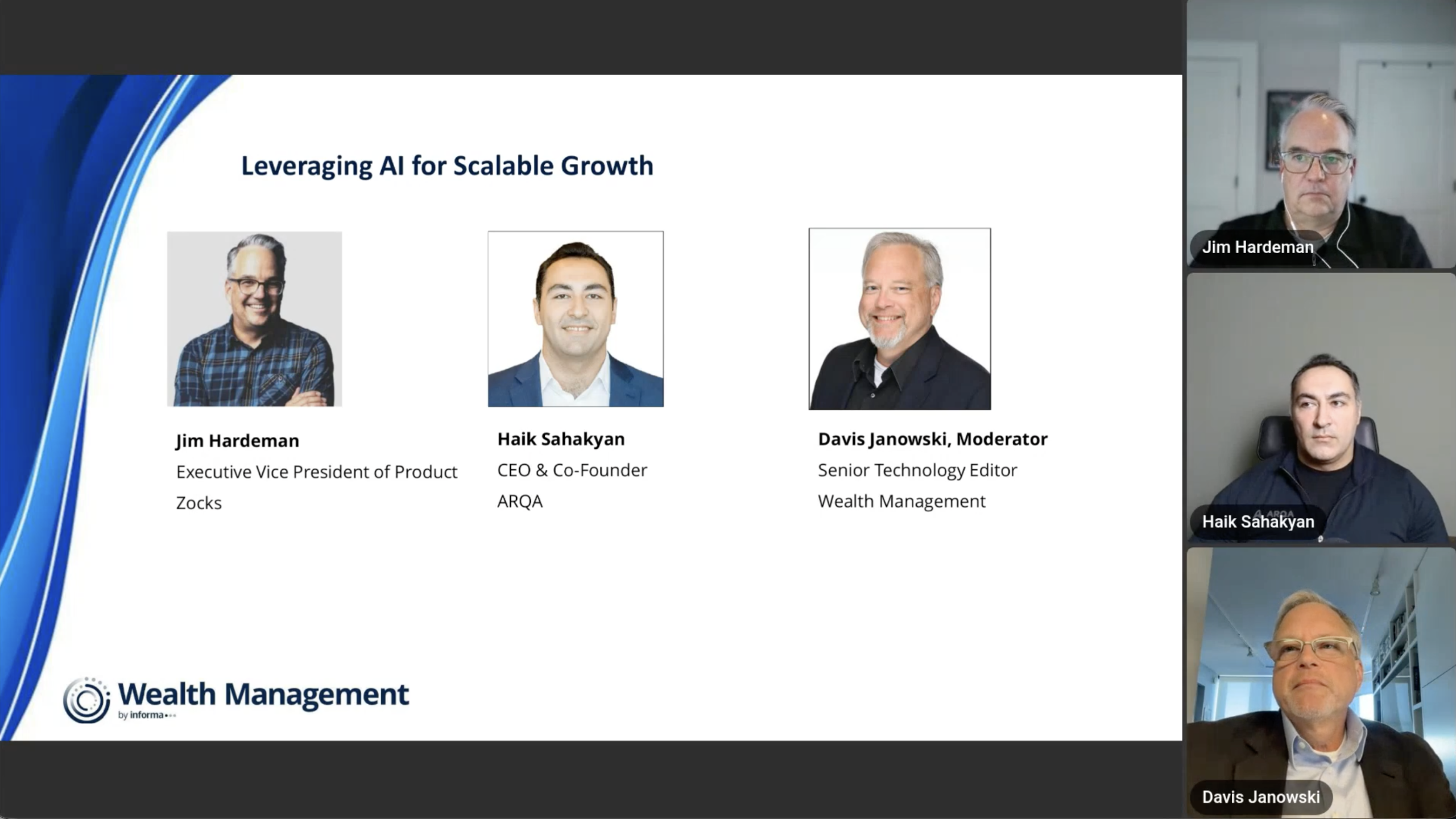
Well, this session is all about using AI to help grow your firm and I’m joined by Haik Zahakian, he’s the co founder and CEO of Arqa and Jim Hardiman, who is the Executive Vice President, excuse me, of Product over at Zox, which is a name many of you will be familiar with.
And since we are talking about growth guys, it’s It’s probably a big reason why an awful lot of folks in the audience are joining us.
And for those not familiar with Arca Hike, maybe you can start off and you can give a brief introduction of yourself and a little bit about what Arca does. And then Jim, you can jump right in after Hike.
Yeah. Thanks, Davis. And great to be here with you guys, with Jim. So at Arca, we’re really focused on a problem that I think a lot of wealth management firms can relate to.
Over the last twenty years, we’ve spent a lot of dollars buying technology, CRMs, custodial data platforms, document management systems, and yet somehow people are still copying information between systems, chasing down approvals, manually moving work across one piece of tech to the other. And it’s kinda crazy when you think about it with all of the tech enhancements that are out there. So what we’re really doing is, at Arqa, trying to limit, how much overhead you’re supposed to take on as your firm grows, as your clients grow, as you take on more systems by being the connective tissue between those systems.
So the tech you’re already paying for, how do you actually make it work? So we’re building the infrastructure that allows AI agents to actually get the work done across the systems you already have in your current tech stack. And as you can see on the slide here, we believe that 80% of what firms need operationally is pretty similar across the industry, understanding the docs, the data that’s on them, working with the custodians, processing any of these requests. The other 20% is what makes each firm unique, their rules and approvals and how they do their business.
So rather than having every firm and reinvent the wheel, we provide the common foundation and let them configure the rest around their business. And we’ve done this with some of the larger broker dealers, RIAs, all the way down to advisers who just wanna leverage AI with their existing tech stack moving data from one system to another. And, ultimately, we want firms to be able to grow without having to keep adding the same amount of operational overhead every time they add more business, and that’s what we really see as the opportunity for AI and wealth management.
Want to jump in there, Jim?
Yeah.
So hello, Davis and hi, great to see you again and excited about our conversation today.
I think without getting into a lot of the details specifically about ZOX as far as our founding and the areas, thought this might be helpful just to kind of get some context around who is ZOX and what do we do? So ZOX is primarily designed to help save time, help advisors know and better service their clients, serve their clients as well as identify organic growth opportunities in their existing book of business. So to kind of put that in practical terms, Zox can help with everything from scheduling meetings to preparing for meetings. We have nearly 50 deep bidirectional integrations with the planning tools, the CRMs, the tools that you’re using in your practice today that helps with things like meeting preparation. So what typically could take anywhere from thirty to forty five minutes to prepare for a meeting that can be done automatically and using our own agents as well as connecting to others to bring data in from various data sources.
Obviously, most people know us from a note taking and data capture standpoint, it’s something that where a lot of firms will start in order to start saving time, freeing up time for more organic growth.
We think we do it quite well. We turn anything from a conversation, a document or an email into structured data, and then that structured data can power downstream workflows. So everything from following up with the client, kicking off workflows, mobilizing the staff, scheduling that next meeting with the client, working with platforms such as Arca, and we have a great case study that Haik and our teams have worked on together that we can cover a little bit later. And that includes things like onboarding, opening accounts, helping advisors build financial plans, do tax analysis, do tax planning, estate planning much faster, and then ultimately being able to look across the book of business, looking for opportunities within that book of business where they can engage better with the client, provide more services, identify growth opportunities for maybe services they’re not offering or addressing needs that have gone unmet for the client.
So all of this works in a kind of a full circle. We really think about, do we focus on really automating and providing tools for that advisor client journey first full circle.
Well, thanks, Jim. I always like to kind of start when I, both in my reporting and when we’re doing these summits, to set the scene, because our audience I’m sure is probably pretty diverse in terms of size and AUM scope. So I wanted to maybe get each of you to talk a little bit about, is your solution or everybody… Is there a sweet spot in terms of the size of the firm typically, whether it’s AUM or number of advisers, etcetera?
I’ll I’ll take it first. You know, Davis, it’s funny because a lot of firms do expect us in the age of AI to come out with an AUM number, and that will determine if they’re a fit or not. But really what it comes down to for Arca is complexity.
I’ve seen smaller firms with five or six different systems, multiple custodians, and a ton of manual processes. And then you have much larger firms that are actually pretty streamlined and standardized in their tech stack. We can essentially work with both. So we tend to work with broker dealers, larger RIAs, and firms where there’s a lot happening across the org.
Yeah. But what’s interesting is that once you build that infrastructure, there’s really no reasons for smaller firms to not benefit from that same effort that you’ve taken on. So you shouldn’t have to really go out and build it yourself. So complexity is really where we look at it, and we love to have those conversations with the clients where it’s like, let’s take one workflow, and then from there, it expands because ideas start popping up and everyone in operations wants to streamline certain things that they thought weren’t even possible.
But once you kind of unveil the tech, there’s a lot that you can do with them.
Okay.
Let’s talk a little bit about where you guys see and, you know, there’s maybe not a general answer here. Our own wealth stack study, found this was back in March. We found that only about 16% of the firms and this was of a survey of 400 and around four fifty firms, only about 16% had an active production agent running out there. I am curious where in the journey are most of the firms you guys meet with in terms of adopting AI or trying it out or full on production with a foundational AI? Is there a typical place you see them or is it still sort of all over the map?
I’ll take that one first, if you don’t mind, I think with us launching, it’s been about three years now since we launched and obviously three years ago, it was very much experimental. And I think at this point, when you do the surveys or you ask those types of questions in audiences at conferences, everybody raises their hand at the advisor level, everybody’s experimented with AI in some aspect of it.
And I think where we’re seeing now, and now that’s kind of a couple of years into the journey, we are starting to see a big variance across firms where they’ve adopted it.
Obviously, most people are going to start and I think that’s a lot of places where people might adopt a tool like Zox for note taking or time saving, but where we see the big differences now that you’ve accumulated a lot of this information and you’re starting to organize it and be able to leverage it over a couple of years, they’re really starting to do more longer running, more complex workflows, as well as starting to mine that data for organic opportunities. So the value is compounding for the firms that have been at this for a while versus the ones that are just starting or only focusing on time saving.
Yeah. And I’ll just add on that at T3, I think 2024 in Las Vegas, No one… When we started demoing the Arca to them outside of the… At the kiosk, you know, a lot of people just didn’t even know that was possible with AI. But what you’re finding right now is a pretty mixed bag. Almost everybody has played with AI. They use ChatGPT, maybe rolled out a meeting assistant.
But there is still a huge difference between the AI helping you write an email and actually doing work within the business. And that’s where things get really interesting and and a little more complicated, because now you’re talking about accessing the real systems, handling them, audit, who has control of what. And what we found is that the best place to start isn’t some massive AI transformation project where everyone thinks everyone has to use this or nothing. It has to be just with one process, and it could be one task or one user and then slowly kind of expanding across the firm.
Maybe you guys could help me out and probably a lot of the advisors who were in the audience by, know, Jim, you showed that infographic early on.
Yeah.
Maybe you guys could zero in a little bit more on sort of where they had to do sort of a layer cake of their tech stack or draw a picture.
Where would each of your solutions sit within the tech stack or to the side of it, or kind of how would you visualize that to help illustrate for the advisors?
I think this is one of those questions that is really interesting for us because, and I think, I think the ability to put something like Zox into a category that exists is a little bit of a challenge because we’re both the UI layer or the experience layer where the advisor can fully interact with Zox’s capabilities, but we’re also deeply embedded into other applications and workstations. It can operate headless.
It can be a data layer for a lot of primary data when it comes to conversational intelligence.
And Jim, not to interrupt, but That can is a phrase I just had an advisor yesterday asking me, what does that mean, headless?
So Zox is API first. So we have organizations that you wouldn’t know that you’re using Zox to analyze a conversation, transcribe and turn that into data. So they’ve built their own experience on top of Zox and it’s kind of runs as a utility or infrastructure in the background.
And I think it kind of goes back to your previous question. I mean, we have to build to… A solo advisor needs to be able to come in on our website, start using ZOX and have immediate time to value. They don’t have time to configure or build or customize or do all of those things. They just need software that works all the way up to the very large enterprises that are deeply embedding ZOX into their infrastructure and other workflows. So I think it can really run the gamut and Zox plays a role, not only at the experience, but the data layer, the orchestration layer and even the intelligence layer. So there’s aspects of the platform that can play an important role in all of those particular layers.
And one thing I’ll do actually, Jim, I think with the client that we’re both working on, if I can just give little bit of that example and kind of talk about it.
Yeah. So I think Jim and I are actually approaching different parts of a pretty similar problem. Right? Yeah. Take a client meeting, for example.
As Jim said, data starts coming out. You can run-in headless and the experience kind of can be customized, But you capture the conversation. You figure out what the client needs, maybe even populate certain relevant forms, and that’s really useful. Right?
But then what really happens from there is I think where we’re pushing the bounds of what AI is doing today. Someone still has to make sure the information is correct. They have to check what’s required from the custodian, get the right approvals, and actually get the request completed. End of the day, you need to provide deliverable work.
So that’s really where we spend a lot of time at Arca with the client in mind that we’re talking about where a lot of things are coming through the funnel from Zox and are getting aggregated by a bunch of advisers, but we’re connecting all those different systems at the back end to help these agents carry the work through straight throughput. And the nice thing is when we don’t have…
You don’t you don’t want the firms to actually…
Because you have small advisers and then a big one, but you don’t want these firms to rip out their existing tech day one. So that’s where I think, to Jim’s point, when you can land and expand into their workflows and then find out what works or what doesn’t, you wanna make the technology that they’re already paying for work, and then you wanna kind of expand on what the capabilities can look like after that.
Yeah. And this particular customer that we’re talking about is they give choice. So they give choice to their advisors on CRM, on their financial planning tools. They have a lot of options, but the unifying factor is Zox has been able to build kind of an ongoing evergreen client profile, collecting data from all these interactions, sync that to their custom workstation, and then Arqa picks that up and can carry that through to open accounts at multiple custodians through a custom back end. So that’s a great example of orchestration and collaboration across different platforms and systems. So it doesn’t have to be one it doesn’t all have to be one size fits all and it doesn’t have to be one vendor, but we all play a part in these types of workflows. And that’s basically comes down to architecture and what the firm wants to ultimately deliver as their experience.
Going back about three years, my life first got taken over by generative AI. And just over the last two years, we’ve started to talk about, and we’ve already been talking about AgenTik AI, but for the sake of the audience, can we go into a little bit more about what the foundational AgenTik AI readiness would mean?
The language itself has gotten, to me, it’s gotten very confusing. The practitioners, the consultants, and even some of the vendors, they refer to foundation layers, orchestration layers, data layers, overlays.
Could you guys just go over a few of the key terms that you think best serve to help build a reference for advisors that may be just sort of starting to shop or have started to look, what are the key terms, in terminology that they should have sort of top knowledge, ready knowledge about when it comes to AgenTik AI? It should be in their vernacular.
Yeah, it feels a little bit like jargon. I do agree with that.
I think you still need to start with what is the business problem? And this is at the end of the day, what are you looking to solve and understanding where there is value, what are the outcomes that you’re looking for.
As I mentioned, Zox can play various roles in that. And I think, from our perspective that we’re a platform that the firm isn’t gonna outgrow. So you’re gonna have time to value immediately by using Zox, saving time, having quality notes that gives you better data at a foundational level. And then you can grow into doing more and more automation over time. But I think it’s understanding the platform capabilities, the architecture, the flexibility to adapt the software to meet your business needs and your way to play as a firm versus forcing you into maybe a point solution or a rigid structure. So, it’s really important for us to be able to support the solo advisor up to the large enterprise, in even in custom use cases like what Haik and I were talking about with this common customer for us.
Yeah. And I think one note to make, Davis, and I I I know you’ve heard me say this before is I think that we’ve done a pretty good job in our industry making something relatively straightforward sound incredibly complicated Yeah. And bringing a lot of jargon in when it’s not necessary. But, you know, everybody’s got a new name for a layer, a data architecture or something, and these are gonna transform as technology transforms.
But I…
We really boil it down to four things. What information can the AI access? What can it understand? What can it actually do?
And who has control over it? And that’s what really matters, especially in wealth management because you can’t just have the AI agent running around doing whatever it wants. It needs the right permissions and approvals and oversight. So we like to allow our clients, even the client…
The the client that we collaborate on to micromanage these agents to know exactly what they’re doing, what their what their behavior is like when they have something unexpected that comes through the documents because it was handwritten. So always tell people don’t get too hung up on the terminology. Focus on what the technology can actually accomplish and how safely it can accomplish it, especially in a regulated environment. And I think that will open up a lot more doors into other things once you have that confidence in the tech you’re using day to day.
Yeah, I think there’s a, as long as there’s sidelines or guardrails and you understand like how to operate within this highly regulated industry where human loop actually matters. And then the other things that have low risk that can be automated, I think that’s a kind of a sliding scale. So anything that’s being shown to a client or crosses the line into providing advice is out of bounds, but there’s a lot of things that, with these agentic workflows where it can reason over a lot of information, connect to a lot of systems and kind of make its own determination along the way, there’s a ton of value and we’re seeing firms deploy those now successfully, but where there’s human in the loop or customer facing, there’s tight controls around that. So that’s really what you want to look for is this purpose built for this industry or not.
When it comes to data AI, without data AI is nothing. I mean, the LLMs can do certain things, but without the data an advisor has on their clients, it really can’t provide the context needed to be truly valuable. So I want to find out where each of you kind of come from when it comes to the state of data readiness that most advisors should be in. We’ve heard for several years now, even with generative AI, oh, every firm’s got to have their data lake or a data lake house already built based on the size of the firm.
Or is that something that you guys help build them, build build it for them?
But what should they think about in terms of being ready with their data before they engage? Or do they need to?
Yeah.
I don’t know for any consultants who are listening now, I might get myself in trouble for this, but data quality matters absolutely, I think over the architecture of the data. And what I mean by that is that not every firm really needs to spend the next two years building a massive data lake before they can start using AI and doing things that are value add with AI. Most of the information you need is already sitting somewhere in the CRM, your custodial platform, your document, whatever it might be. And the question really comes down to, can you access it with that AI? Can it understand what discrepancies there are within that data, and can it do something useful with them when it does, bring that data in?
That’s the approach we’ve taken with Arca because, like I said, to force someone into that exercise, it doesn’t always make sense depending on the client size and what they’re trying to achieve. If you’re an RA aggregator, sure. You wanna keep an eye on everything and you want everything to come into to to one place and and fill that data lake with as much data as possible. But if you’re an RA who wants to test out AI and workflows and things like that, it shouldn’t be a prerequisite for you getting started at all.
Yeah. Well, I can’t believe we’re already down to almost our last six minutes here. I wanted to get at some some concrete, valuable takeaways for firms when it comes to think about how AI can, foster growth, supercharge their growth. I think it many times the the advisors that are sort of the tip of the spear when we’re talking about AI, those 16 or 20% that have started agents, they’re the firms that are really thinking about growth. So So what are the ways you guys see in the firms you’ve already worked with that first… That that really comes to pass happens? What areas… What are some concrete things they can really expect to to gain, quickly from using your platforms or what you guys build for them?
Yeah, I’ll just, I have a handful of examples, but, and these are on our website. You can go and watch the videos and different webinars you’ve had or download those case studies, but one advisor in particular, they estimate that they’re saving nearly two thousand hours a year just around meeting prep and post meeting follow-up and so the way they’ve redeployed, they used to have their lead financial planner sit in every conversation with the advisor to meet with clients. They no longer do that. They’re providing more plans. They’re doing plans earlier in the prospecting discovery phase versus just with existing clients.
So they’re doing, they’re just adding more capability deploying that that way. We have another advisor we worked with that estimated that they were gonna need to hire three to four people this year.
So far, they’ve been able to acquire 18% new growth in new assets this year without adding headcount. And what that’s doing is they’re also mining the data that’s being captured by ZOX looking for more tax planning opportunities. So they’ve added tax, deep tax planning this year as a new service, and that’s driving higher net worth clients and they’re attracting new clients that weren’t getting that type of service from their existing, maybe advisors such as offering planning or investment advice that they’re bringing in new business owners for tax planning. So I think we’re seeing obviously time savings is where it starts, but they’re redeploying that for adding more services, adding better or deeper services to more clients and bringing shrinking that time between conversation to plan creation, to plan implementation. So a lot of time savings being redeployed to just go deeper with their relationships, existing relationships and acquire new ones as well.
I might push back on Jim a little, Davis, just on the on the metric because I’ve been talking about this a lot, but I think the biggest thing is that we need to stop or shy away from just, you know, looking at AI purely in terms of how many minutes or hours it saves somebody. Because someone funnily enough said, you what are they doing with the hours saved? Are they doing more work? Are they just going golfing or whatever?
But jokes aside, I think it’s about, when you look at AI, the real big opportunity here is about the bandwidth and what you can handle and the quality of work that you do. So for those hours saved, are you doing the best quality of work and delivering the best client experience? I think to me, that’s the real promise of AI, growing the business without having to grow all the complexity that comes with it, having to add people when you don’t need to, and just doing more. But that’s why I’m I’m trying to start a crusade about, you know, it’s great to save the minutes.
To Jim’s point, that’s where it starts, but that’s not the end game. Right? It should be then how do you turn that into quality work that can be repetitive and done at a higher capacity?
Well, in the last couple, few minutes that we have, going beyond efficiency gains in particular, just general efficiency gains, replacing manual processes and the like, what do each of you see sort of on the roadmap for AI?
What do they have to look forward to? Like… And and I don’t mean to talk about a specific category, but for instance, I’ve seen the first few investment management, specific solutions using, Agintiq AI that’s gonna do research, but also can help, you know, reporting and that sort of thing. What else do you guys see sort of on the immediate horizon that firms, especially these… Those that are thinking about growth are gonna benefit from potentially?
I can take that one, Jim, just to kick it off. I actually think that AI could end up being a huge equalizer between wide kind of sporadic sizes of the firms and complexities that we have out there.
What it really reminds me of is like cloud computing back in the day when a lot of large infrastructures were pushing to have something like this, but now everyone has, you know, servers on the cloud that they’re using and leveraging to do everything that they would want and run their business with. So, you know, I don’t think the firms that will win with AI will necessarily be the biggest, but they’ll be the ones that figure out how to use this stuff well earlier on.
So I think, you know, across when you’re looking at everything in your tech stack, it’s gonna be what can you leverage AI to do that humans are doing today, and that’s gonna be the real piece that we can walk away from. So it’s not that specific module like performance reporting. Like, those are all gonna be table stakes at some point, but it’s gonna be more about how can I take the element of the human out of something that they don’t even wanna do? And I know it’s very controversial when we’re talking an AI, like the robo advisors back in the day that they get rid of advisors, but I don’t think that’s happening anytime soon. I think the advisors who are really good at what they do and the job that… The part of the job that they like doing is what AI is gonna enable them to kind of focus on versus having to key in data across two, three systems and deal with swivel chair across their entire org.
Yeah. I mean, a 100%.
At the end the day, the advisors tell us that they value the time being face to face with their clients, having more engaging conversations, showing up and really understanding and knowing the client and more deeply and following up with more personalized outreach, follow-up, personalized advice, going deeper on planning, spending more time on the analysis, all of those things provide a better client experience and eliminating the swivel chair and manual data entry and updates and more of the administrative work is where they’re seeing a ton of value. And then just freeing up their team to provide that higher level of of client experience versus, just getting tasks done all day.
Alright, guys. I think we’re gonna have to leave it at that. We’re already at our thirty minute mark.
I’m surprised Shannon hasn’t popped back in, to shut us off.
Thank you…. Discussion. I’m like, yeah. Could let it go….
Another… Full another half hour, hour probably. But Jim from Zacks, Haik from Arca, thank you guys both.
Thanks, David. Thanks, Shannon. Bye.
Alright.
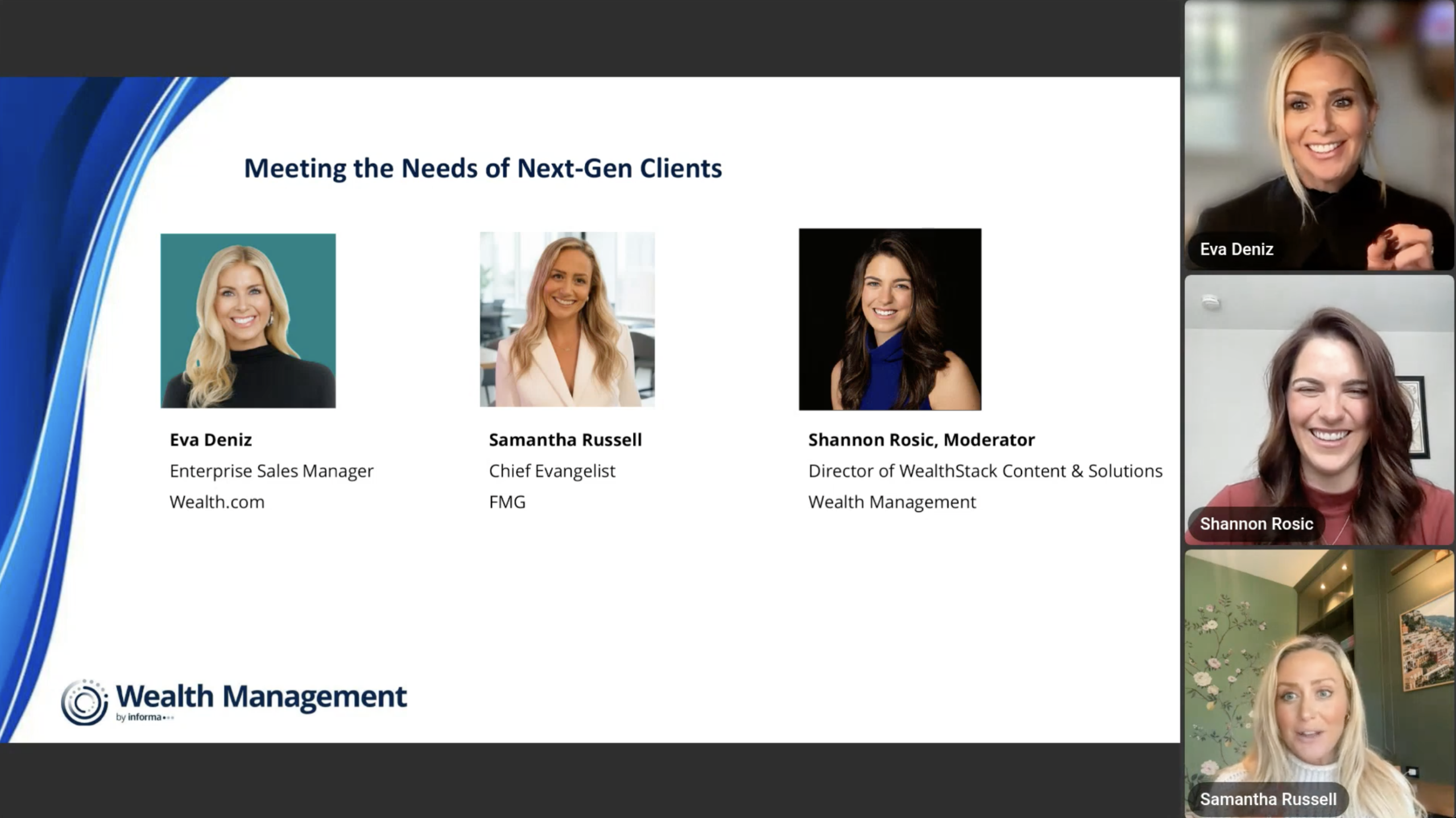
Well, thank you again, Davis, Jim, and Hike. So we’ve obviously just explored how AI can help firms create capacity, but I think what firms do with that capacity matters just as much. So this is a perfect segue into our next topic because particularly, when it comes to the next generation of clients, they have a very different set of expectations. So to help me unpack this topic, joining me today, I have, well, neither of these ladies need much of an introduction as they are the the queens of wealth tech, but I have Samantha Russell, the chief evangelist at FMG, and Eva Denise, enterprise sales manager at wealth.com. So ladies, welcome.
Thank you so much. So glad to be here.
Yes. This is a fun one and a lot of good hair, I feel like, on this panel too, which is exciting.
Likewise, Shannon. Yes.
I was gonna say, usually in the middle of the week, you don’t see me with my hair done like this.
But I know. Was just gonna say I’ve got the dry shampoo going on.
So See, these are these are the important topics that that people wanna know about.
But in all in all seriousness, I I appreciate the two of you joining me because this is an important topic to unpack right now because, as we know, there’s just been a lot of conversation about the great wealth transfer and the trillions of dollars expected to change hands. But I I think we all know that the next generation isn’t necessarily going to choose an adviser the same way their parents did, and they certainly aren’t expecting the same experience. So in this conversation, ladies, I wanna go beyond the headlines and talk about how technology is really changing the way advisers attract, engage those next gen clients.
But first, I wanna see who is paying attention in the audience. Audience, quick poll for you. We’ll leave this up for a minute so you can answer, but we wanna know what’s the biggest obstacle to attracting and retaining your next gen clients right now. Heck, is that even a strategy you’re utilizing right now?
So we’ll leave that up for a minute while we get get into our first topic, and I kinda wanna set the stage with a next gen reality check. And so, Samantha, I’d love to start with you because, you know, it it does seem like we talk about NextGen clients as if they’re all, like, these 23 year old, you know, TikTokers or something. But when you look at how younger investors find and evaluate advisers today, what’s fundamentally different from, say, previous generations?
Yeah. It’s so interesting too because, I think a lot of NextGen really probably looks more like me. Right? I just turned 40, still working. I’ve had a equity event happen, you know, not using an adviser that, my parents use. So it’s definitely, the the idea of what they look like is different, but I think one of the things that people really, really underestimate is we had decades where the only way adviser growth was happening was through m and a or referrals.
And now we have whole slots of the population who’ve never found a business any other way than by doing research online. And it doesn’t matter if they’re looking for a house, if they’re looking for a plumber, if they’re looking for a hotel to stay at. Sure. They still ask their friends, but a big chunk of that research is happening online either in tandem or as the first step or as the step after the the one to one conversation.
So I wanna throw up the poll results real quick so we can ruminate on those for a minute. But…
Oof. Okay. We have a we have a clear winner here. So looks like 42% of our audience said building trust and demonstrating value is the biggest obstacle to attracting or retaining next gen followed by reaching them in the first place. So ladies, we just kind of love your thoughts on this. Eva, I can start with you. Is this kind of in line with what you’re seeing Yeah.
As Totally. I mean I think firms often treat trust and value as like an automatic byproduct of fiduciary status. When Sam was exactly right, this next generation, they’re skeptical of financial institutions or traditional institutions. They’re overwhelmed by the conflicting financial information online, and they expect really an adviser to prove that value before ever handing over any kind of assets. And so, yeah, definitely building trust and demonstrating value.
So, Sam, are advisors adapted?
This would probably be a whole other topic we could talk about, but are they adapting their marketing strategies or using that same playbook and just hoping younger clients randomly find them and, you know, pray that whatever they’re using right now works.
Yeah. I mean, I think overall, not many are adapting, but the ones who are doing it and doing it thoughtfully and intentionally are seeing the results. Right? So, like, to give you an example, we know that for any of us choosing a business…
And this applies really to everybody, but I think more than ever, this next gen, it really is this way. We want to feel like we’re finding someone who gets us in our particular situation, who understands us, who speaks our language, if you will. And one of the easiest ways to do that is to understand the platforms where these people hang out and to speak the language that they speak. So for instance, I cannot tell you how many websites I look at or LinkedIn where people will talk about I offer holistic financial planning.
There is not a human in America that is going to chat GPT saying, I’m looking for a holistic financial adviser. Like, nobody talks like that, yet the marketing hasn’t caught up. Right? Somebody might say, I’m looking for one adviser to manage my entire financial life or to have everything in one place even, like, much more bare bones.
And then when you’re talking, you wanna talk more…
Actually, there’s something, where you can grade your writing. You wanna talk at a seventh grade level in your marketing messaging communications, but most adviser marketing is written at, like, an eleventh grade level. And that’s because when we’re reading social media, we’re not studying for an exam. If we don’t understand it, we just keep scrolling.
Right? So I hate to say it. You don’t wanna dumb down your marketing, but you want it to make it really, really easy to scan, and you want it to be, like, exactly what the person who’s reading it with with the language that they would use. And this is where, you know, your conversations with clients, your AI notetakers, go have…
You know, get a a summary of what are the top questions and exactly the language that will give you a great starting point.
Yeah. That is great advice. Like you said, not necessarily dumb it down, but just don’t overcomplicate it, if you will. So, Eva, I’m curious, you know, say once an adviser does attract that younger prospect, where do you maybe see the traditional adviser experience start to fall short of what that next gen client expects?
Yeah. I think advisers can win the younger clients on the conversation, but then they start to lose them at the experience. And I think it shows up like in three different places, speed, scope, and then I would probably say continuity. Speed, when you think about it, you can open up a brokerage account on your phone in ten minutes, but then when the advisor has the client, you know, handing them a big paper packet going through a three week onboarding process, you’ve lost me.
Then with the scope, like you know millennials, this next generation, their financial life is not mostly investments. It is income, it’s mortgages, it’s equity comp, It’s real questions like who’s going to take care of my kids if something were to happen. And so an adviser, I guess, whose value proposition is just investment management has very little to offer. And then lastly, the continuity.
Like most of these individuals are already…
You know, they are heirs of families that advisers are already serving, and they lose those heirs because they never, you know, bother to meet that next generation. And so I think that that’s where it it just kind of, like, falls off.
Absolutely. So question for both of you then. Sam, if you wanna take this first, are younger clients actually demanding more technology or simply a better experience?
Oh, it’s such a good question. And, actually, you know, it’s funny what you just said, Eva, about, like, you know, the…
So many people. Their parents already have an adviser, but the adviser doesn’t have a relationship with the kid yet. I think that those initial first meetings and warm introductions shouldn’t be about investments or the money at all. Like, the money shouldn’t be mentioned.
It should be about anything that you can help with that proves your value and that you’re there for them without the money being there. Right? So something like, maybe somebody’s only in their twenties, and they have their first big job that they’re negotiating for equity comp, and you can help, you know, contribute to that conversation. That is going to be way more powerful than any login or portal or, you know, the conversation about the investments.
Right? Because for them, right then and there, they’re not thinking about the thirty five year time horizon when they’re gonna retire. They’re thinking about how do I get the most equity I can in this moment.
Yep.
Absolutely. So, Eva, before we move on, any final thoughts around, you know, demanding tech versus just the overall better experience? Do next gen investors care about tech, or they just want things to work and know how to speak to them?
Yeah. I mean, I think that the AI component, the tech is great. You know what I mean? Like, it is giving us real answers in real time. Any adviser that tries to compete with that is is not going to.
But I think where the advisor, you know, leading in that way, I think where the advisor comes in is like to connect the relationship to, you know, the advisor to be there when the real questions happen. How do I negotiate? What do I do with my stock options? Things like that. You If think about it, this next generation does business very differently than the generations previously. You know, we don’t necessarily get a pension and retire. You know, it’s, it’s a lot of assets that aren’t really tangible right now that, you know, can seem a little… You know, make an adviser a little outdated if they’re not proactively addressing that, and ChatGPT or Claude is giving that information.
Alright. Well, then speaking of ChatGPT then, Sam, I know this is a topic that you’ve talked about a lot because if younger prospects are increasingly turning to ChatGPT and other AI tools for financial questions, How does that change the way advisors need to make themselves discoverable online?
Yeah. There’s so much to unpack about, you know, how do you get AI, whatever tool it is, ChatGPT, Copilot, even Google, because Google gives us the AI overview at the top. How do you make them recommend your business and…
You know, in that particular scenario? There’s a few things to think about. The number one piece of advice though is if you are not clear on who you serve specifically, then AI will send no one to you. And I’m gonna repeat that again because most advisors that I look at their marketing, they’re trying to attract everyone.
Think of a magnet. For a magnet to work and to attract on one side, the other side must repel or the magnet is broken. So if AI does not know who you are trying to attract, it sends no one to you. So there’s three things you need to be found and recommended by AI.
Number one, you have to have that clear ICP. Who is the target person that I help? How do I help them? And what are the types of benefits they get, you know, by working with me?
Very clearly demonstrated. The second thing is having authority.
Have you won any awards? Have you been featured on a podcast? Have you contributed to a magazine or a newspaper article? All those kinds of things really help show that you don’t just believe this about yourself, but that other authoritative places have invited you to share your insights.
And then the third thing is that you have social proof. So this could be having the CFP letters behind your name or a CPA, like those credentials, but it’s also things like testimonials and reviews, which we have seen become increasingly important for advisors. So it’s not just I say I’m great, and I work with business owners who are…
You know, need help with succession planning in Saint Louis. But look at all these other people who live in Saint Louis who said, yeah. I had a business, and I worked with Samantha, and she helped me with this. So those are the three, you know, buckets, and there’s very specific tactics under each one.
But you…
It all starts with getting clear on who you want to be sent your way in the first place.
Oh, that is great advice. So, Eva, I’m curious, you know, say that younger client walks through the door, how can advisors demonstrate value beyond kind of the basics, you know, say, like, portfolio management?
Where can technology actually create a more comprehensive relationship? And I can imagine from the side of estate planning, like, that would be a a great way to engage that next gen client.
You’re absolutely right. That would be my first thing, the estate planning conversation. If you think about it, you know, we all know whether what age you are, we all know that we’re going to die. For these younger families, you know, that conversation is literally, you know, the first thing that they need, but it’s the last thing that they think about.
And so leveraging a platform like wealth.com, being able to facilitate the conversation, helping you know that family get guardianship in place, get a will in place, even you know having the conversation of do you have updated beneficiaries in all of your accounts and then starting to I mean that builds a lot of trust right out of the gate to say here let me put a plan in place for your children, and then from there having those planning conversations you know the questions you know should I exercise my stock options, can we afford the bigger house, what if my spouse you know, steps away after maternity leave and doesn’t go back to work?
How does that affect the taxes?
And then I think you know just really like leaning into the relationship, connecting with the family, I think that’s how you produce instant value that that solidifies the relationship indefinitely right out of the gate.
Oh, absolutely. And it’s kinda going back to the trust side of things. Like, we understand the full picture.
Yes.
Let’s get this figured out and then go from there. So I think that’s a great point. So, you know, question for both of you and Sam, I’ll start with you because we obviously have more tools than ever to automate our marketing and communications and planning.
But at what point does automation make the client experience feel less personal? Because I know as a millennial, and I’m sure you ladies know too, like, you know immediately when something is AI slop or has this been the spray and pray method. So, you know, help help advisers out here.
Yes. So I think the the big thing is I think people are…
Especially younger generations, they’re okay with somebody using AI to create something that helps them. But the key is it has to be specific for them. So it’s not that AI was used to help create it. It’s that it wasn’t just for them.
It was for everybody. Right? And so the key is to whatever it is you’re making to have it personalized for the person you’re making it for. So to give you an example, I don’t think there’d be anything wrong with using AI to draft up a, you know, a recap of the meeting you just had and how…
You know, what the next steps are, what needs to happen next. Because it’s all about, hey. We talked about this in the meeting. These are the next steps.
Right? And AI is helping you draft that. You want it to still sound like you. But where you start to lose people is when you create one email with AI and you send it to every single person on your list, and it’s not personalized for them at all.
So what I like to think of is letting AI take away a lot of the, you know, manual, like, laborious items so that you can add the personal touch where only you can do that. So for me in in attracting next gen, think about recording a video that you’re gonna send to just one client’s child or maybe a a family. Right? So the client and their significant other, and you say, I talked with your mom and dad.
They…
You know, we were talking about their plan the other day. They gave me your email, and I just wanted to let you know, you know, I’d be happy to set up a family meeting and talk with you. They mentioned you’re getting a new job. There’s maybe gonna be some equity.
And, like, you’re saying this in the video, like, here’s a link to my calendar. That is where it…
You really can shine and and have that human aspect come into play.
Speaking my language with the video, so say it louder for those in the back. I completely agree there.
But, Eva, curious on your perspective too.
Yeah. I mean, I completely agree. I think the, technology is meant to automate the work, not the relationship and so that’s where the advisor comes in. I mean if you think about it, we were kind of talking about the estate planning conversation. Every advisor has those clients that are in their 70s. We’ll just call them the Brady family.
They, you know, have an existing estate document, hasn’t been read in years. Advisor typically would just file that away in a filing cabinet. Instead, they could leverage technology to visualize that trust, to unpack, you know, the roles, responsibilities, unlock that conversation and then that introduces hey you know does your daughter know that she’s in this role? Boom, setting up a family meeting where the advisor is able to sit down with that adult daughter to kind of talk through roles, responsibilities.
That adult daughter then you know now understands you know the impact, who to call when mom and dad pass away and then says something like I actually have a baby and I don’t have my own documents in place and so you can see where the technology has automated the work, but now, you know, the advisor has not only capitalized on the relationship with those existing clients but then retained that next generation too. And so it’s the personal touch that we still want, but we want things instantaneously and visual. And so leveraging both, I think, is important, but the adviser’s still knowing the role there.
Man, Netflix and Amazon really ruined all of us, with really instantaneous results.
To to your point, Eva, let’s do a little scenario or role playing if if you will. You know, say you’re the adviser. You’re advising the 65 year old couple for the last fifteen years. They have 5,000,000 in investable assets, two adult children, you know, in their early thirties. You’ve never met either child. Right. The parents are revisiting their estate plan, and a significant wealth transfer is on the horizon.
You have ninety days to start building relationships with that next generation. You know, Sam, I’ll start with you. Like, what do you do? You know, how would you engage those adult children? You know, what would you communicate, you know, through what channels even, and how would you make the outreach relevant rather than transactional? So loaded question.
Well, I first wouldn’t assume that you have no relationship with them. Like, I don’t know about, like, for all of you, but my parents are in their seventies. When they’re talking anything about money, I’m making sure that they’re not being scammed because just candidly, they have a harder time, like, identifying scams. Sure.
So I wouldn’t be surprised if the kids, the adult children haven’t looked at your website, looked at your LinkedIn, some of those types of things. That’s number one. And so you wanna make sure, of course, that that is relevant. But I would ask the parents for a warm introduction right away, right off the bat.
I But wouldn’t just say like, oh, I wanna talk to them about their…
This inheritance. I would say, knowing that we’re creating this legacy and this estate plan, what are some of the things…
You’ve told me what’s important to you. What are some of the things that are important to your kids right now? What are they going through? Are they buying a new home?
If they get this type of wealth, what are some of the things you think they might wanna use it for? I kinda pick the parents’ brains first and get to know the kids through the parents. And then I would create a warm introduction handoff whether that’s a text message we’re all in one chain or an email we’re all in chain and suggest setting up what we call a family meeting. So you get everybody there together, and you’re gonna go over that estate plan and what it means. And you’re talking about more of the legacy building and, you know, just all of the components of the estate plan, but you also then are able to tap into the things that you now know were important that the parents told you about those kids. And then you can offer to help the kids with those things before you ever start talking about managing the money.
So say, Eva, then, you know, we get through this process, the kids agree to the conversation, you know, how would you use technology and planning then to demonstrate value and turn that first interaction interaction into that ongoing relationship? You know, maybe even walk us through on on the waltz.com platform, like, what that conversation could potentially look like.
Yeah. I think you can separate it out exactly what Samantha said, but separate it out into, like, a ninety day window with three different phases. Know the first thirty days you’re prioritizing the conversation with the family. You know they’ve got a huge estate, nobody knows what’s in their estate documents so leveraging technology to extract that, provide a visual.
Then from there, you know, the second phase, you’re setting up that family meeting where you’re taking that visual that AI has delivered, you’re unpacking roles, responsibilities, and then the sixty to ninety day window, you’re setting up those one on one meetings with the adult children to not talk about any kind of, you know, nothing about their parents but then engaging on their own goals. I mean typically, you know, these are, you know, adult children in their 30s, jobs, equity, you know, mortgage, kids. There’s a lot to talk about that can come out, you know, very organically by setting up those two other phases and leveraging a technology just to paint the picture.
I mean, nobody wants to touch estate planning because it’s like death, death, and I don’t wanna read a 150 page of legalese, but it’s very disarming to flowchart it to, for lack of better terms, to kind of dumb it down to where I am able to understand what is an executor. Is that a silly question to ask? No. It’s not, and really gets conversations going.
And you just made me think too. I think one of the things is not overwhelming people with everything at once. You know, you talked about breaking it down. One of the things we have in FMG is the ability to set up sequences that have delays in between.
So you send this email, wait six days, send this one, wait three days, and you can choose the delays. But we have a lot of advisers that use our…
We have a family meeting template where the email’s already written for you, a worksheet that you can go through. It’s already designed for you. So you can pick and choose the pieces that you want, but then, of course, you wanna add in the message that, again, we talked about personalizing it. But doing it on a delay and having a tool that allows you to do that where you don’t have to keep remembering, like, hey.
Like, look at your calendar. Oh, it’s day three. I gotta send it. But just write it all at once, but put it on a delay so that way, you know, they’re not overwhelmed by the information.
So what happens then scenario pivot if we have a problem child then that says, I already use AI to answer all my financial questions. Why would I need an adviser?
How would you recommend that they respond?
I’d love to hear from both of you saying I would say great.
For you start. Yeah. Please. Good. I think great. A…
I mean, AI is great for answering, you know, financial questions. Like I said, any adviser that’s gonna compete on answering questions, you know, as fast as the consumer wants to read them is going to lose. But the caveat is, like Samantha said, AI only knows how to answer the questions that you ask and so the real value of the adviser is to answer the questions that you don’t know how to ask. So great.
Use AI.
But Right.
The adviser I also agree from a psychological perspective. Whenever you compliment someone first and you’re like, that’s so smart. I’m so glad you’re using it. Like, they are now gonna wanna hear what you have to say next.
And to your point, not only not knowing the questions asked, but I think people are starting to see more and more that AI always gives you the best answer it can give for the most number of people. Like, because, yes, it might have a lot of details about you, but it doesn’t have every single thing. And so it’s gonna give you the best answer that’s the aggregate. And, you know, there might be some…
We’ve all had that experience where we’re talking to chat to the team. We’re like, oh, wait. I forgot to mention. It’s like that changes everything.
Completely changes. Yes. And you can even kinda show that in real time, like, a scenario in, practice it at a time so you know, like, when that happens, and then be like, okay. Now wait.
I forgot to say this, and then show them how the AI tools, like, that changes everything. Here’s what we would do instead, and kinda show them, again, all of the the nuance that they’re not, that the AI tools aren’t gonna be always be aware of.
Yeah. And I think that the AI…
Like, what the advisers value is providing context, judgment, and accountability. Like the context, advisors know the context more than ChatGPT or AI does. The judgment. I mean Samantha, you said it perfectly.
Like AI is going to give you the answer that you want, know, it’s not going to, it’s just the average answer. It’s not personalized. And then I think that accountability is the biggest one. You know, the adviser is the one that’s going to be there when it’s a hard phone call or a parent has passed away.
And so I think absolutely use AI to get smarter, but use the adviser for the decisions that are honestly too important to get wrong. I think that’s that’s really where the the adviser is, pivotal.
Absolutely. I mean, at the end of day, you’ve heard it a million times. It’s still very much a relationship based business, and you’re not gonna be calling up chat GBT when you’re panicking about something. You’d rather hear from…
I mean, so maybe some of you do then. That’s fine. That’s a whole other discussion, but you’re gonna turn to your adviser for, like you said, that judgment and just consistency and and clarity on things. So just a couple minutes left here.
If you guys are okay with it, we’re getting some audience questions, so I’d love to put you both in the hot seat. And before I do that, just a last minute call out.
Wealth.com has provided some great resources in the resource widget, and I know FMG, you’ve been kind enough as well to to offer some… Let me throw up the slide real quick, so hopefully everyone could see that.
So is everyone okay with the hot seat? This is just where you Yeah.
Absolutely. Bring it on.
This is a good question I feel like to wrap up on, and whoever would like to go first tackle it, go for it. But the question is, what are the main obstacles, you see when dealing with and communicating with younger generations or aka our generation?
Main obstacles.
My gosh. I always am, like, reframing every obstacle as an opportunity that’s, like, unconditioned to think about it.
I mean, I think that one of the things that, you know, maybe it’s an uncomfortable truth, but that every firm should be asking themselves is, like, are we a firm that this younger generation would want to work with?
Do we understand them? Do we know what’s important to them? So that might look like, is everyone on your team thirty years older than the types of clients you’re now trying to attract? Maybe you do need to do some work with, like, finding and retaining younger advisers that will understand the communication nuances and things of this younger generation.
So just, again, meeting people where they are. It’s kinda like, you’ll hear me say, you shouldn’t have one type of social media post and then just use that same post on Facebook, LinkedIn, Instagram, TikTok. You wanna understand the nuances of each platform and what’s popular there, what are the trends, and then create content that fits that platform. It’s the exact same thing here.
You know, what appeals to someone who is 70 is gonna be different than what appeals to someone who’s 30. And so, you know, make it your job to not just assume that, you know, they should wanna work with you because you’re so knowledgeable and wise, but that you wanna take time to understand what’s important to them.
Yeah. I I agree with that too. I think, I think also too, like, digital presence is huge.
I mean, performance will keep the clients, but the digital presence really decides if you ever get to meet them. I think that, and then I think the estate planning conversation is really undervalued. You know, referring out to attorneys, it breaks up the relationship, and I think that’s, like, a huge expectation now is integrating that, into the plan before, you know, talking investments, assets, etcetera.
Yeah.
Alright. Last one, and then I know we have to wrap. But one final question, do you find that prospects, especially next gen clients, are actively avoiding materials generated by AI, and do they find advisors less authentic now if they find out they use it?
Oh, what are you guys hearing?
I… It’s funny. I am very much around a lot of, like, preteens right now, like, really, really young because of my kids, and they all immediately are like, oh, that’s AI. That’s AI. Like, point it out and dismiss it.
So I think if it’s so obvious it’s AI, then, yes, people kinda dismiss it, like, as not even worth their attention in a lot of ways. But as I mentioned before, I think if you, you know, make a big graphic in Canva, and Canva definitely has, like, an AI tool that can help you make it, but there’s… I’ve seen Canva graphics that you wouldn’t know if someone just made it in Canva or they use AI to make it. I don’t think anybody’s faulting you for that. I think where people start to fault you is they read a post of yours, a social post, and you’re like, it’s not this, it’s that. And you and you just sound so not like yourself, that’s when people start to dismiss it because it just sounds like you took the easy way out. So I think it’s really all about that perspective of it. Like, is it obvious that you took the easy way, the shortcut, and you’re not making it personal?
No. That’s great. You could take us home.
I I I don’t think I would be bothered by an adviser using AI. Again, like, AI is to automate the work. The adviser needs to really lean in the relationship. I think, you know, leveraging, you know, flowcharts or anything that makes things easier for me to understand and conceptualize is great, but I think the call to action for advisors trying to capture this next generation is again reframing the way that they think about the conversation. We’re not focused on investments and assets. We’re focused on, you know, the planning conversation, the career, the mortgage, like those things I think is what really solidifies, you know, the next generation choosing this advisor. I don’t care if you use any kind of AI as long as you’re authentic in your conversation and what you want for me as a client.
Exactly. Use it as a tool, not the overall solution to attract next gen clients. Ladies, we gotta take this one on the road. This is the good one, but, seriously, Sam, Eva, thank you so much for your time.
We’re gonna roll right into our next panel. We’ve now talked about, you know, creating capacity and using tech to deliver a better client experience, especially when it comes to next gen. Now comes the million dollar question.
How do you know if all that technology is actually paying off? So our final session is all around workflow automation ROI, and I’ll hand things over to my colleague, David Armstrong. So, David, take it away.
Thanks, Shannon. That was fantastic.
Have a fantastic panel so far, but I think we saved the best one for last.
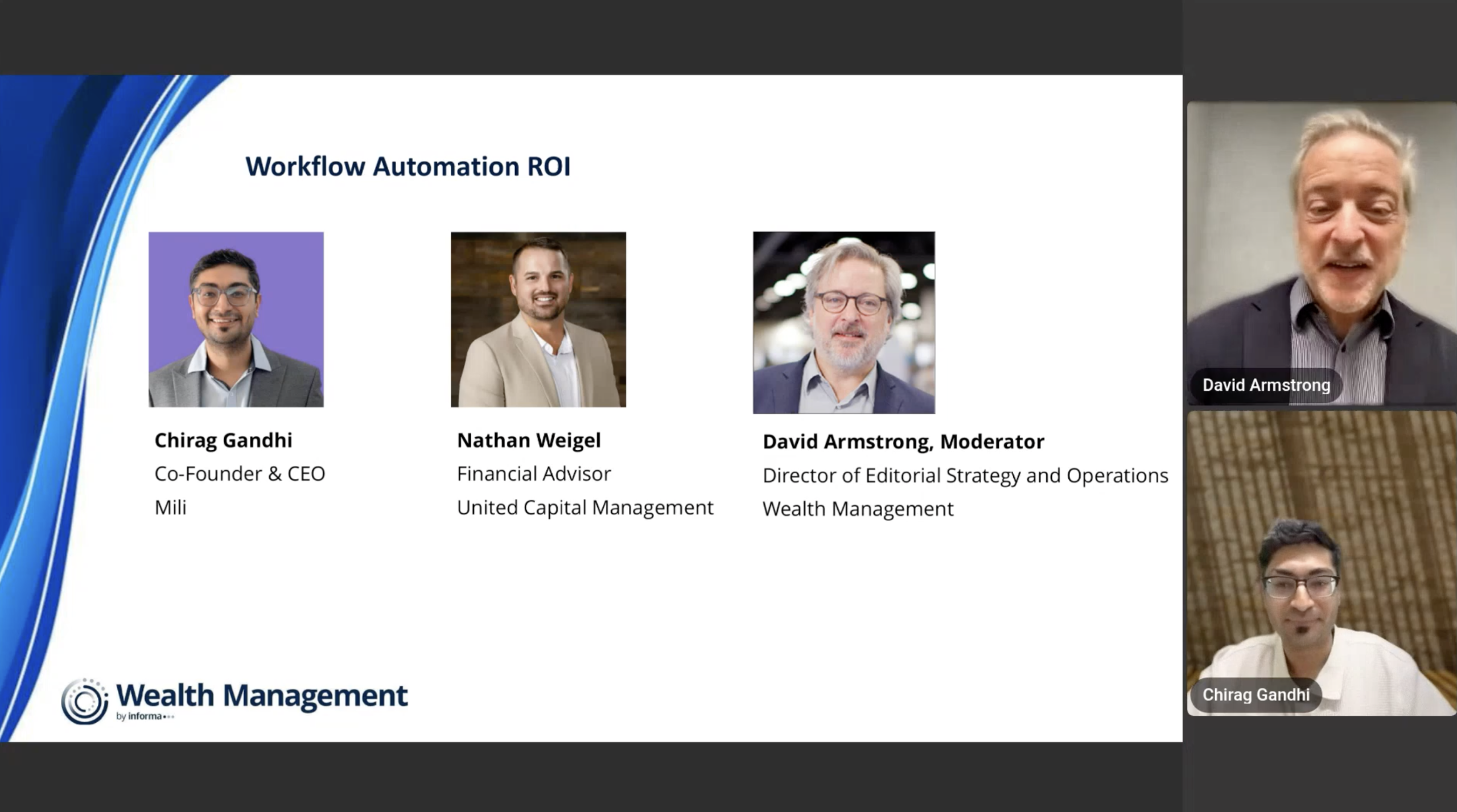
Joining me up here on the stage to talk about return on investment and how advisors should think about ROI when it comes to AI and workflow automation. I’m joined with Nathan Weigel, who is the financial advisor with United Capital Management and Sharag Gandhi, who is the co founder and CEO of Milli.
And Sharag, I guess I will kick it off to you first just to talk a little bit about your firm. Why don’t you just give us a quick introduction to Milli and how you approach the sort of the ecosystem of wealth management, particularly when it comes to AI?
Absolutely. David, thanks a lot for.
There you go. Yeah.
So thanks a lot for the introduction. Okay. I tried to send in.
You have two two portals open?
Well, I guess we’ll wait for Shrug to come back, and I don’t know if Nathan is with us. Nathan, are you, going to join us on the stage?
I guess we will wait for Charag and Nathan to join us again.
Was gonna say this is where you need AI to Exactly right.
To be able to solve things.
Exactly right.
Well, Shannon, mean, I guess we could talk about, know, has been a great conversation so far. You know, strikes me that AI and advisors, we can’t even… There’s no such thing as a technology conversation anymore without a conversation about AI.
You know, it’s just a… It’s changing everything. And I think a lot of advisors, I think particularly advisors with smaller firms, are always a little bit puzzled about how to jump in, how to start, where to go.
You know, if you’re a part of a large enterprise, sure. But, you know, if you’re running a small one, two person shop, maybe a paraplanner and a junior adviser, where do you even begin? You know, how can… Are some of these tools… Are they beneficial to you? Can you use them? Can you use them in compliant… Compliantly? Can you use them effectively?
I I… Right. That is… Think the number one question, but I don’t think it matters what size you are. And again, everyone’s heard this a million times. If your data is not in any good compliant place, then you can’t even begin to dabble with AI. So, Drag, I see you’re back, so I’ll let you jump back in. Yeah.
Thanks, Drag.
Drag, we’re talking about return on investment here.
You’re a technologist.
So you wanna just tell us a little bit about Millie a little bit and where you’re coming from, then we can jump into the conversation.
Absolutely. So I don’t… I have a few slides. Let me quickly So for the context for everybody, it depends on IT for advice.
We think of it like an AI workforce that works alongside your team and takes off all the work around advice availability in meeting prep, onboarding, tax planning, data management, so on so forth. Today, have hundreds of advice forms on the platform that can now comfortably hand back work to AI agents. And what I’ll be sharing today is what we see across those forms.
Now, a lot of times these panels become vendor overload. So we will also try to have Nathan join in.
And for context, Nathan at United Capital Management is the top 2% user on the Mealy platform by just how much work he has been able to delegate to AI agents.
We will also shortly have a poll running on on the right hand side, and we would love to hear from you and the audience on where is your form today in that AI journey. So do take a second to to answer that as well, but excited to pick up the session with you, David.
Yeah. Fantastic. And while we wait for Nathan to come on up to the stage here and give us the adviser’s perspective, I would ask you, Truc, you know, you speak to a lot of advisers. You see their… At their various points in their technology journey. How do you see advisors right now using AI?
Oh, I’ve lost Chrog now too. Okay. There he is again.
Yes. Okay.
There you are. All right. Trag, how do you see advisers using AI?
So that’s a that’s a great question. And the framework that we have is really emerge emerge is really three things.
The way we look at it is is there is ask ask, there is automate, and there is alert alert. Right? Right? So for me to think about it is as a form, where are you in that learning learning learning learning learning learning learning You ask a question, agent, of my clients have we not spoken to in the last three months?
Well, we have firms asking which of my clients in the CRM have done QCDs, for example, and and pull that up from the CRM. Right? The second is automation. So you can hand over AI a complete job where you come back to reviewing the work that comes out of it the other side, and we see forms doing this as well and growing client capacity, the number of clients they can serve.
But the most interesting one is actually AI alerting you instead of you asking AI to do things for you.
And this is the holy grail of where we are headed.
We have advisers on Milli asking it to create alerts, for example, if the stock drops 20%, right, or if there are clients that have some beneficiary forms that are due for review.
And in those cases, Millie alerts them. And it is with alert that you can get growth in your practice and your book as you can actually organically grow assets by identifying opportunities.
That’s great. Nathan has joined us. Thanks, Nathan. Thanks for getting up here. Appreciate it. No worries.
Listen, I’m glad you’re here. We were going to start off, you know, a little bit talking about the return on investment, how you think about return on investment for using AI in your automated workflow.
And maybe you could just take us into a client meeting, a typical client meeting that you have.
And where does AI come into play in your work as an advisor?
So where it comes to play for me is the first the first aspect of just recording the notes. We allowing allowing me to be the agent of the client.
So I used to take the notes by hand and then set them aside immediately to go to the following meeting and then go to the next meeting.
Same thing over and over and over. Well, this has now allowed me to…
This… Can you still hear me?
Okay. This is this is now allowed me to be a better better individual and client to where I can be focusing on the meeting and then not have to go right right away to my CRM and take those notes and put them in there. But it it puts me back at that meeting maybe eight to ten to fifteen hours later. And it literally, word for word, I can…
It it just takes me back, and that’s that’s the aspect of where I’m at of just on the note side. But outside the note time, the planning the planning aspect that I I got a meeting come up. It can look for signals. They can give me the rundown on them.
It can it can remind me that maybe they had a baby or they had a new grandbaby or they just took a trip. And those those triggers allow me to ask ask individual about that. And so those things make it more personable to where I’m not just worried about taking a nose in in that aspect, but just the personal level. But then, you know, as as I said earlier, the amount of hours it’s allowed me to save on the prep and on the back end to be a better adviser in the middle when I’m facing that client.
Yeah. That makes a lot of sense.
I don’t… Tara, does that resonate with you at all? I mean, you know, it strikes me we were just talking with Shannon about the there are various sizes of advisors out here, right? The platforms that they’re on. And I understand an advisor on a large enterprise platform may have one experience with AI. A smaller adviser in a smaller shop may have a totally different, experience with AI. How do you think about that in terms of how AI is used sort of along the spectrum of the adviser size?
So interestingly, David, what we see is at the core, the argument is generally made for productivity gains, and that’s what AI starts off unlocking. And it’s about what do we do with that excess time that we end up saving that’s very important.
But the way the productivity gets articulated is very different by the size of the firm. For smaller advice firms, one to five advisers, typically, is about…
I I ideally just don’t want to be hiring a client support or a or a success.
That’s that’s not probably a good way to be building this practice out. Right? So we so we definitely see that. For slightly larger firms, we see them wanting to scale rapidly while, again, ensuring that they can do that in a sustainable manner. And for the largest private equity backed RIA platforms, it’s very much about doing their exit multiple, going from 10 x EBITDA to 20 x EBITDA. But that comes across also from building a high quality business, and which is what Mili ends up supporting them. But, yeah, it would be good to hear from you and Nathan on on how you’ve seen that seen this play out.
Yeah. Fantastic. And I should remind the analysts that we do have a poll going on the side there, so please fill that out. We’d to know how you’re using AI.
Nathan, just turn it to you. Where… I mean, you you talked about note taking. You talked a little bit about financial planning. How would you say that AI has paid off in your practice, not just in terms of I’m able to, you know, record my notes and take a picture of them and put it into my CRM? But how has it paid off in terms of efficiency and time saving?
Where where are you on those levels?
Well well, realizing that task task that that is from the from the meeting. So so Immediately from the meeting meetings. And by the time those meetings are done done, hey. It gives me six or seven follow-up tasks that I gotta do for this client.
And and before, I would had to take my notes and and been like, okay. Where did I circle something or where did I ask for something or or anything like that? But just having the tasks there and then obviously, I might go back and make sure that I didn’t miss a task. But having the task, who said it, who said what, how it was said, what they’re wanting to do, what the next step is, who the next step is on is is key.
And then being able to immediately relate that to the client, maybe even before they exit. Hey. Here’s here’s the next steps before our next meeting or, hey. In the next seven days, this is what we’re working on.
That’s been that’s been substantial for me. And then and then while they’re in there even, you know, maybe maybe it’s something in Excel or PowerPoint or anything like that, but being able to create something that is client facing in a matter of short time…
And, yes, I’m gonna go back and I’m gonna look at it before I before I show the client. But, again, like like the previous panel talked about, as long as it’s individualized for those clients and it’s providing them value, I’ve I’ve got a lot of positive feedback about the usage of it. And and even my my my boss came in one day, he’s like, oh, who who created that? And I’m like, MeliAI did.
And he was like, oh my gosh. You know? And and it was it was a it was a great mind map of a brother and a sister possibly looking to to consolidate and move move in together and how it could save them. But, you know, just the overall picture of what it was gonna do to their finances, insurance, and just their lifestyle.
So so things like that, but then also just other agent, you know, whether we’re creating a family tree or, talking about beneficiaries of accounts, and maybe maybe they’re working with an attorney. And I’m like, okay. Here it is, and here’s who the beneficiaries are. And it it makes it a little bit clearer clearer than what is an actual report maybe look like from Schwab or Advise on.
And, and the client the client liked it. The, the the attorney gave me positive feedback on it. So so things like that. You know, I’m not an expert in PowerPoint.
I’m not an expert in any Microsoft tools. So how how has the AI tools helped me have more time to be at my table with a client or prospect servicing them?
Let me ask you just to… Maybe is there a way that you can characterize or quantify the amount of time that it has saved you?
I know it’s probably all just back of the math, of the envelope math, but give us an idea of, like, you know, how much time is it really giving back to you?
So if I’m gonna calculate how much time it’s gonna save me, I’m gonna say that over the course of a year, it it it probably saves me around a thousand a thousand hours, you know, fourteen to eighteen to twenty hours a week. Just depends, you know, what…
What’s being used and what’s being, with with the notes and the meetings and and the preparation, though, in that regards. You know? And and and that’s not like…
Like like they said in the previous panel, it’s not like I’m gonna go out and golf. Hey. How can I? Whether I’m gonna go prospect or whether I’m gonna see these next five clients and work on some Roth conversions or how can I better utilize that fourteen hours time that I used to spend taking notes and doing things that I didn’t like, like I didn’t enjoy doing, you know?
So…
That’s a significant amount of time. If that’s bringing that back to your practice, that’s another way to impress the boss, I guess. That frees up a lot of time. Chuck, does that jibe with what you find too?
Or how should advisors think about the time saved? How should they measure the impact of it using AI on their practice? Is it just simply hours saved? Is it a financial consideration?
How should they look at it?
How should a firm measure the return on investment otherwise?
That’s a that’s a great thing to give. The way we’ve seen it is typically be out in in three different vectors. One is client capacity. Now the number of clients you can manage as a…
As an adviser is also a function of how much depth of service you you offer. Right? So, obviously, this is not to say if you’re working with one ultra high network household, you should suddenly take on 10 family offices. That’s that’s not the gist of it.
But in in that depth of service, there is always an opportunity to be working with both clients and household or or offering deeper services to them. Right? So we typically see advice from Stella going from 80 clients to one twenty clients per household on an average across our across our book over the last year, which is which is great. And and for me, personally, this is very meaningful.
This is a teacher or a veteran, somebody that may otherwise not have had access to great financial advice actually get that. Right? And and that’s very fulfilling.
The second is also the speed to advice, and these are proxy proxy numbers. But today, takes anywhere from one to two months to actually deliver that financial plan, align on that financial plan, all the back and forth in collecting data, onboarding forms, etcetera, we have seen forms cut the time in in half. Right? And and get that much faster. We, in fact, now are getting to a place where this can get to in in a matter of weeks where you can onboard a new client and have their financial plan built from Milli, which is, again, very important and goes back to the first point. The faster the cycle is, better is the client NPS, and better is our ability to sort of work with them in the long term.
And the last is the the gearing ratio, right, for what is the support staff to adviser ratio in the team. And, ideally, it’s it’s not like AI is truly taking away jobs, not that we see that on the ground, but it’s very much how do we enable everybody in the team to do their best possible work and be their best possible version of themselves. And this is where we see a lot of efficiency and productivity gains play out as well. So these are really three value levers we’ve we’ve seen play out across the board.
That’s that’s interesting. And I’ll ask a question that may be an unfair question, but I’m gonna ask it anyway. I… And either of you can take this, and then we’ll move on. But as an adviser realizes those efficiency gains and those time savings gains, where do they put that time towards? Is it better to put that extra saved time towards onboarding more clients? I mean, you point out there that people are going from typically from 80 to a 120 clients per adviser.
Maybe some advisors would rather say, I’d rather stick with my 80, but spend more time with those 80, maybe discovering greater share of wallet or different pockets of assets or resources in there that I haven’t advised on yet.
I don’t know if you have any insight into that, Chirag, or if Nathan, if you want to talk about how you know you kind of make this trade off, what you do with the efficiencies that are provided to you from the AI tool.
When somebody walks into our door, you know, the…
One of the best things that we take pride in is the client experience. And and as your number grows from 85 to one twenty or one twenty to one fifty, you know, you you start to look at your book and see, okay. Where where…
Where’s all these pieces fit in this puzzle? But I I don’t wanna eliminate the sweet old lady who’s living on Social Security that has grown to be my grandma. You know? So so I might just give her a, a a client review and service her as as I seem fit.
But, hey. When when a business walks in the door and it allows me to do more than just financial planning on a a retirement scenario, but business planning, tax planning, succession planning, and then estate planning as well with their family. What…
Do they have long term care? And so really going through that full that full plan with, a new a new prospect or a new, even even, like, the next generation. You know, our previous panel talked about the the great transition of wealth, and, you have ninety days. Right?
So if my client…
If my new client is growing and and then I…
I’ve got some old clientele over here, I’ve gotta figure out a way to start building…
To to make sure that I have an income at some point, you know, and getting those people in ninety days. Ninety days. That’s that’s quick. You know, three months to retain those assets upon death.
And I think the stats over over sixty to 70% leave their their parents’ financial adviser. So, you know, I gotta be be efficient, teach teach myself, and find and find a way to transition to value to to the to the client or the prospect.
That’s interesting because you’re talking about using artificial intelligence as a way to kind of create maybe more bespoke client experiences for different levels of client in ways that maybe you couldn’t do effectively or efficiently. You could do them before, but not as effectively or efficiently. So instead of giving the client that sort of templated experience, you’re actually kind of crafting the plans for each of them. That’s interesting. Chag, one question for you. You know, we were talking earlier about small advisors versus enterprise advisors. You know, an advisor could spend $20 on ChatGPT or Claude or… You know, and and kinda build some of these tools themselves.
Could they not? Why shouldn’t they do that?
So ever since one of the flagship conferences in wealth management, I’ve had this conversation with advisers pretty much every week, and, it’s it’s definitely tempting.
But I think a a lot of the security concerns that the industry has had with AI still continue. Right? And to to actually to actually paint the the picture behind why I why I call out compliance and security still being really important is… Let’s take Claude, which is obviously a leading lab that’s that’s doing a lot of things right. Right?
But the way they build this product is if you are not careful, there are 10 different toggles or 10 different gotchas on on the platform where you could just inadvertently end up sharing your data with the platform where they could retain it for forty, sixty, ninety days, and also train their upcoming model on it. And the question is, do you want your clients’ Social Security numbers, account numbers, addresses going into these twelve year models.
And at Meli, with all of our subprocessors, given our scale where we now do million agent grants, tasks, workflows, what have you, we have been able to get to a place of strict zero data retention, no training, understanding of what models work versus not. And I would recommend any adviser on the call to take a screen grab of this. Right? And even if you do use Claude, run it against this checklist to make sure you you do not… You’re not falling prey to any of the common sort of pitfalls in in using these tools.
This is very important. And if you are a small advice firm, you do not have the time or the team bandwidth to be figuring all of this out, and, honestly, you should not be figuring all of this out. So where platforms like Milli, first of all, come out as as a safeguard, right, which ensures that your data is in in the right hands.
But the second is it’s not just as simple as building out one tool, and I really recommend all advisers to go out there, build something personally as well. But when you start looking at an AI native advice form and you’ve taken on this project with some of our enterprise partners, it starts all the way from the source systems, getting the data in one place, building out one common dictionary or vocabulary for these agents to actually work out of. And even after the agents are built, who in the team gets access to what agents, who gets access to what data, scenarios, approvals are all still important. Right?
And this is where a partner comes in in in streamlining all of that, so it’s not wild wild west as it relates to implementing AI for your practices.
And it’s it’s it’s a bias take. I I do take it, but this is very important and which which is why we think the right answer here is neither to build or buy, but actually truly partner with an agent to get platform that can help you get to that promised land in in days and weeks and not years.
That makes a lot of sense. Nathan, you wanna talk a little bit about how you all handle client data on AI platforms at UCM?
How do you think about it?
Very, very, very, very, very guardrail. So, you know, we don’t wanna necessarily be the front runners like some people are.
We’re we’re more on the back end of let’s see what happens after the ball ball blasts. Here here and see what’s gonna evolve over the next twenty four to thirty six months.
And just to piggyback off that last one, you know, with Millie, the the the Millie team that’s just like legit… The car manufacturer.
Hey. Just wanna drive the car. Just wanna know if I’m using Millie. I wanna know how it’s gonna help me. You know? Heated seats, all the bells and whistles, my life like being sterile. That’s that’s the way I look at it.
You don’t need to know how to build the car. You just wanna drive it down the road. Exactly.
Exactly.
You know, I guess as we kind of have the final few moments here, Nathan, I would ask you, an advisor listening to this, you know, kind of taking the first steps into AI and workflow automation, what should they do first? What would you recommend they do first?
I would find the bottleneck of where where your your individual day to day endpoints are. So everybody has them. Everybody experiences them, you know, but take your take your three biggest bottlenecks. And then, you know, right here.
He’s right here. Get get on the phone. Get on the Teams call, Zoom call, whatever, and figure out how a company can help you, eliminate those bottlenecks or at least suppress them to where they’re very minimal. That’s the biggest thing in in today’s world is these bottlenecks and…
In in in our business and what’s taken away our time from doing our biggest money making activities. And, we joked about it on the prep call, but, you know, for for the price of a a cell phone bill, you could… You… I mean, enterprise level, obviously. But you could go and you could go and get some, company like Millie to help you on your day to day. And and rather than hire an assistant, you can really hire a company, and then you can train that company to to work together with you. And and I think that’s the biggest the the biggest advantage that people who do this are gonna have over the people who have assistance or anything like that.
Yeah, that makes sense. In last minute here, I do see a question here that’s popped up, and I did want to get to it, Turag, and I’m going to throw this one to you. Someone is asking, from a data security standpoint, you know, how are AI platforms different from any of the software as a system platforms that we’ve been using for the past fifteen, twenty years?
Are there different security considerations that we should think about?
I I love this question, and it does paint a a contrasting picture. So one, I think it’s important to understand AI is a lot of the same. And by what I mean by that is this is still a system where you are providing some inputs, you are getting some outputs, and it’s it’s still a tool that you are using in your practice. It is it is not a person, which means everything needs to be reviewed by the adviser.
You will not blame a calculator or a spreadsheet if the model doesn’t work. You’ll blame the adviser for making the bad recommendation. Right? So…
Or or the market. But that’s that’s important. And and the same holds true also for AI. AI is a tool, and it should be used as such.
Now what is different is that it’s a black box. Unlike software where a click of a button does what it does, in AI, the same input could lead to 10 different outputs. Right? So what that means is every part of this black box needs to be broken down and understood.
Every every component needs to be understood, which is one, what are all the inputs that are going into this black box? And do we have control over each of these data that reads? Who in the team can access what data layers? Right?
The second is what exactly is the black box doing? And that’s called explainability, but the core premise is do we understand what’s going inside inside that box? And the last is when the output does come, what are the guardrails you want to set on top? So even accidentally, it does not end up going straight to a client, right, or that’s something that it should not be doing.
So can we have enough guardrails on the output which we also can’t control? So it’s so it’s very much like software, but it…
Because it’s like a black box, you need to understand each of these components and work through them differently.
Yeah. Fantastic.
I don’t know.
Any final thoughts here as we wrap up this thing? Nathan, final thoughts for you? One of the things I think we talked about during our prep call that I thought was kind of interesting is, when we’re talking about the return on investment and work automation, workflow automation and AI, you need advisors to actually use the tools that you’re providing them. This is probably more on an enterprise level. You can give all the advisors all the access to all the tools you want, but unless they’re using them, they’re not So going to recognize some of is there something that you think about in terms of how you can get advisors on board who are maybe a little bit reluctant or just don’t kind of, you know, it’s not in their wheelhouse, it’s not part of their day to day? How do you kind of push them into making sure that they’re getting some of these efficiencies that we’re talking about?
At at the end of the day, I’m gonna worry about what what is affecting my day to day. And I’m gonna invite them to that’s able and allow them to see what the software that that the AI and this is ability can do for us. Right. Right.
At the end of the day, what’s I’ve seen help and then an adviser come in, and he’s like, hey. Explain a little bit about Millie. And I was like like, okay. And we’re having a little conversation.
But I was like, hey. Come over here. And I showed him for, like, ten minutes. He was blown away.
He was like like, oh. And what’s that cost? Something like like x amount. Oh, okay.
I think I really can’t use this. It’s gonna fit for this, and it can fit in my day to day business.
And so that’s that’s the thing. It’s you can… It’s the same way that you’re sold on it. You can get told and told and told about it. But until you get into it, then you can see the value that can provide you.
Yeah. Yeah. It’s a, you know, show, don’t tell. That’s what we say. Right? They gotta see it.
And once they see it, then that’s that’s convincing. Chirag, any final thoughts here?
It’s, for us, been a very interesting journey over the last three years. I recall there was a time when we were evangelizing AI and why it’s important.
Meeting note takers were like a magical portion in the industry, and you couldn’t get sort of more of it. And clearly, on the poll right now that we ran, it it looks like 60 to 70% of attendees already have some version of meetings that are that are taken care of, which is which is great. And it’s all about what’s next. Right?
And identifying clear use cases where AI can help you and then working towards those use cases. It’s easy for a vendor like me to come on on stage and tell you 10 different ways where AI can change your practice. But the reality, like Nathan said, is where where…
What’s working for you and your practice. Right? If your firm is actually all about buying other advice firms, do more of that with AI. Right?
If your firm is all about growing organically, finding leads, do more of that with AI. If your firm is all about the personal touch point, actually signing pieces of paper to your clients and handwritten gifts, do more of that with AI. So it’s about accelerating and and bringing out the authentic version of you versus trying to automate away something that’s that’s actually not helpful. So those are my final parts.
Yeah. Fantastic. I… We’re at our time. In fact, we’re a little bit over. You know, there are some questions here that we didn’t get to. I think we… Our speakers will get to those questions, so we’ll send those questions to our speakers, and they can answer if they are so inclined.
With that, Shannon, I think we’re we’re done here with our portion.
Alright. Well, thank you, David, Nathan, Gerard. I think if there’s one theme that connects today’s conversations, it’s that growth isn’t about adding more tech. It’s actually about making that technology investment work harder for your business and your clients.
So big thank you to all of our speakers, sponsors, ARKISOX, wealth.com, FMG, and Millie for making today’s go through as soon as possible. You probably already saw that survey pop up on your screen. So if you wouldn’t mind taking that, that just helps us out.
And, again, if you’re looking for CE credit, all of that information is in that resource widget along with additional resources from several of our sponsors. This entire summit has been recorded and will be available for on demand viewing, and you can just access it using the same URL that you used today. So really appreciate you audience, and, again, apologies for for audio issues there, but we do appreciate you spending a portion of your day with us, and we certainly hope you walk away with a few ideas you can put into practice as you plan for 2027. On behalf of wealth management, thanks for tuning in, have a great rest of your day.


